My mother showed up at my restaurant on a Friday night, right in the middle of the dinner rush, and walked past the host stand like she owned the place.
Not the way proud parents do when they finally see what you’ve built. Not wide-eyed, taking it in, letting the success soften whatever edges time carved into your relationship.
No—she came in the way bill collectors come in. Like she’d already decided what she was owed.
I saw her before she saw me. I was at the pass, leaning over a row of plates while my sous chef Carlos called out times in Spanish and the line hissed like a train—pans clanging, burners roaring, the sharp clean smell of seared scallops and lemon oil cutting through the heat.
“Chef,” Carlos said, and his voice dipped. “That woman at the front… she asked for you by name.”
I didn’t need to ask which woman.
I looked up through the window into the dining room and saw her standing by the host stand in a stiff cardigan and faded slacks, hair dyed an unnatural auburn that didn’t suit her. Her posture was rigid, chin high, eyes scanning the room with that familiar expression—half contempt, half calculation.
The last time I’d seen my mother in person, I was eighteen. I’d been holding a duffel bag and a scholarship letter and a simmering rage so hot I couldn’t speak without shaking. I’d walked out of her house and promised myself I’d never go back.
Fifteen years passed.
Now she was here, in my restaurant, in my world, with white tablecloths and polished glass and a reservation list two weeks long.
I wiped my hands on my apron, told Carlos to watch the pass, and walked out.
The dining room wasn’t quiet—not fully. There were conversations and laughter and the soft clink of forks, but the moment I stepped through the double doors, it felt like everything narrowed to her.
My mother turned and smiled. A practiced smile. The kind she used at PTA meetings when teachers asked why my lunch smelled like sour milk.
“Sweetheart,” she said.
The word landed wrong. Like hearing a stranger wear your name.
“Don’t,” I said softly.
Her smile tightened for a second, then returned. She leaned in as if we were close enough for that. “We need to talk.”
“Not here,” I said.
“It’s important,” she insisted, louder now. A couple at a nearby table glanced over. Mom didn’t care about causing a scene if it got her attention. She cared about control.
I took a breath through my nose, slow, the way I taught my line cooks to do when something was about to catch fire.
“Back office,” I said. “Now.”
She followed me through the dining room like she belonged there, and I felt the eyes of my staff track us. I hated that. I hated her for making my restaurant witness my family.
In my office, I shut the door and didn’t offer her a seat.
She looked around at the framed reviews on the wall—one from the New York Times, one from Bon Appétit, a local magazine cover with my face beside a headline about “a chef who turned survival into art.” I watched her eyes flicker over it like she was reading numbers in a bank statement.
She didn’t congratulate me.
She didn’t ask how I was.
She got right to it.
“Keith can’t support me anymore,” she said. “The house needs repairs. Social Security isn’t enough. I need help.”
I stared at her.
It was almost impressive how quickly she could skip the last fifteen years like they were a commercial break.
“You haven’t called me in fifteen years,” I said. “Not once.”
She waved a hand like that was sentimental noise. “We’re not doing that. I’m here because this is the practical reality.”
“Practical,” I repeated, and something in my throat tightened.
She nodded like she’d won. “I found a retirement community. It’s very nice. It has a dining room, activities, medical staff on site—”
“How much?” I asked, because I wanted to hear her say it out loud.
“Eight thousand a month,” she said. “But listen—your sister and you can split it. You both do well. Colleen’s a hospital big shot, and you—” she gestured toward the wall, the reviews, the restaurant—“you clearly have money.”
I laughed. It came out sharp, ugly, and it surprised me because I almost never laugh that way anymore.
My mother blinked. “What’s funny?”
“You,” I said, and then I was shaking. Not visibly, not theatrically. Just a tremor under my skin like my body remembered.
She narrowed her eyes. “I raised you.”
I didn’t respond.
“I kept a roof over your head,” she continued, voice rising. “I fed you every day. And now it’s your turn to take care of me.”
Fed me.
The word cracked open something old and rotten in my chest.
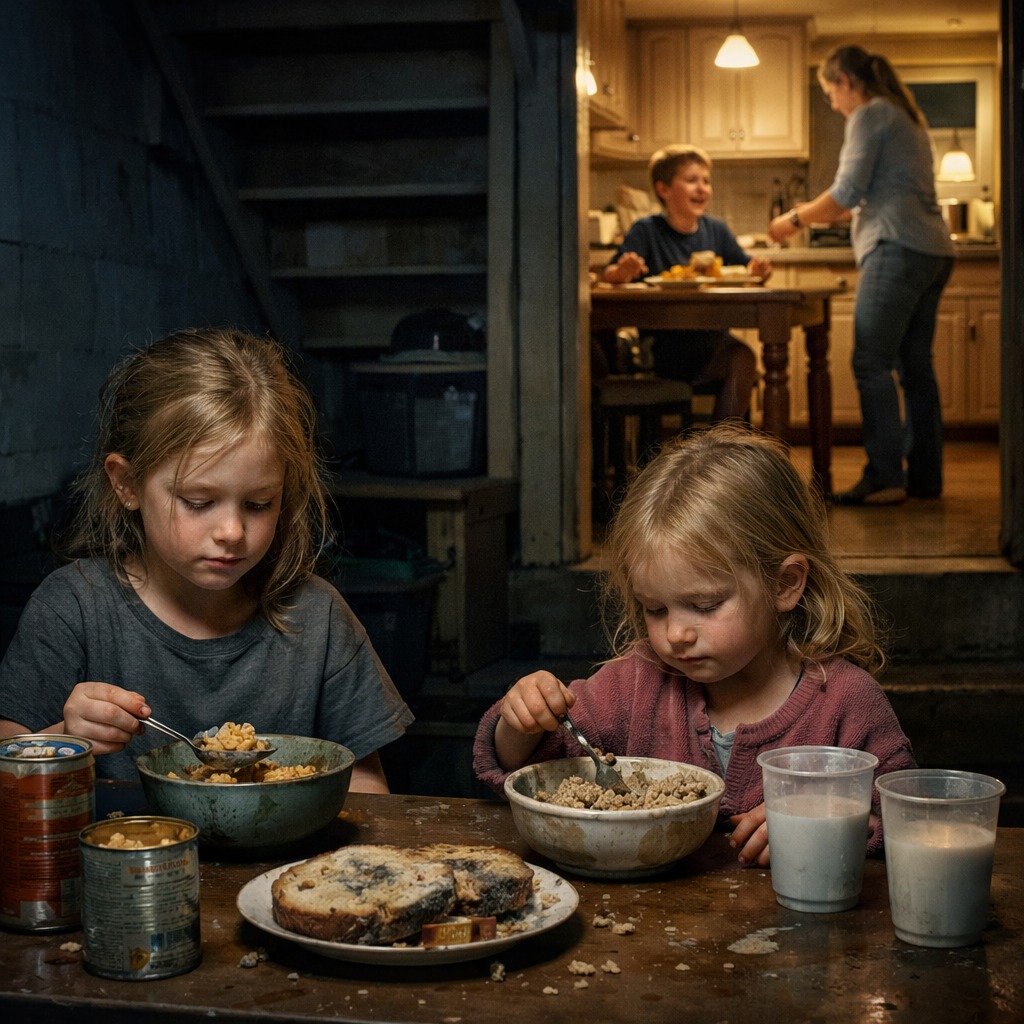
I pictured the basement fridge.
The dented cans with labels peeling off.
Milk that smelled like pennies and sickness.
Bread with green fuzz scraped off and handed to us like it was normal.
My mother watched my face, and I saw her misinterpret my silence the way she always had—like stillness meant submission.
“So,” she said, leaning forward. “We can start next month. I already spoke to the facility. They have an opening. I’ll send you the paperwork.”
I looked at her for a long moment. Then I said, evenly, “I need to check something in the kitchen.”
She nodded like she’d just closed a deal.
I walked out, didn’t go to the kitchen, and instead pulled my phone from my pocket with hands that were suddenly ice.
First, I called Colleen.
She answered on the second ring. “Hey—what’s up? You okay?”
“Mom’s at my restaurant,” I said. “She wants us to pay for her retirement home.”
There was a beat of silence so dense I could hear Colleen breathing.
“No,” she said, flat.
“I know,” I replied. “Meet me at her house tomorrow. Bring Jack.”
Colleen didn’t ask why. She didn’t ask if I was serious. She just said, “Okay,” in that voice she uses when she’s stepping into triage mode.
Then I called Russell.
Russell wasn’t technically my lawyer—he was a friend from culinary school’s weird cousin orbit, a guy who’d worked his way into a decent practice doing contracts and civil suits, and who owed me exactly two favors because I’d catered his wedding at cost and once saved his brother from choking on a steak.
When he picked up, he said, “If this is about a liquor license—”
“It’s about my mother,” I said. “And I need something… special.”
Russell paused. “What kind of special?”
“The kind that fits on paper,” I said. “And hits like a hammer.”
Russell didn’t laugh. “Tell me everything.”
By the time the sun set, my mother thought she’d shown up and collected her due.
She had no idea I’d already started building the invoice for her past.
I didn’t always know our childhood was abnormal.
That’s the thing about kids. They think the world they live in is the world. When something is all you’ve ever known, you don’t question it until someone else reacts.
It started when I was six.
Colleen was four.
Keith was ten.
See more on the next page
Advertisement
