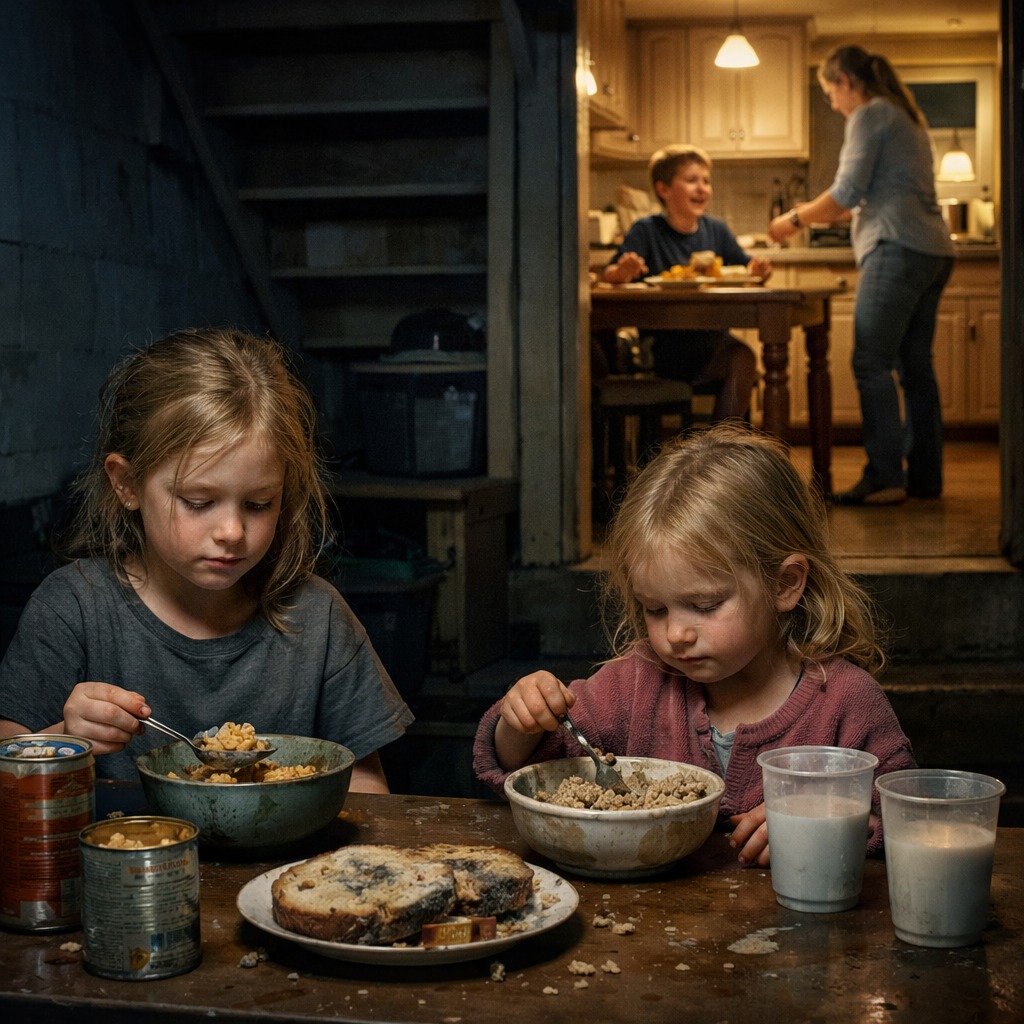
Dad had just left—packed a duffel bag, muttered something about “not being cut out for this,” and disappeared into whatever life he chose that didn’t include us.
Our mother became a different person after that. Not softer. Not braver. Just… sharper.
She kept us alive, technically. She kept a roof over our heads. She made sure school forms were signed. She showed up to parent-teacher meetings.
From the outside, she looked like a struggling single mom doing her best.
Inside the house, she built a hierarchy.
Keith sat at the top.
Colleen and I lived in the basement.
Not literally sleeping down there—we had bedrooms upstairs—but food? Food was basement business.
Every Saturday, Mom went grocery shopping. She’d come home with bags of fresh meat, vegetables, bread, milk—real groceries—and carry them into the main kitchen like she was stocking a normal life.
Then she’d pull out a second bag. Smaller. Separate. Like contraband.
It would have dented cans. Bread with mold spots. Milk that was “on sale” because it expired tomorrow. Yogurt already past its date. Lunch meat sealed in a package but gray at the edges.
She’d take that second bag straight to the basement fridge, the old one in the laundry room that smelled faintly like mildew and onions no matter how much we cleaned it.
“This is your food,” she’d tell Colleen and me. “This is where your food goes.”
Keith ate from the upstairs kitchen.
We ate from the basement.
If I tried to take an apple from the upstairs fruit bowl, Mom would appear like a ghost.
“What do you think you’re doing?” she’d snap.
“Getting an apple,” I’d say, confused.
“That’s Keith’s,” she’d hiss. “Stop stealing from your brother.”
I learned, by eight, that hunger was less painful than her screaming.
The first time I got real food poisoning, I was eight.
Mom had packed me a sandwich with expired lunch meat. It didn’t smell right, but I was a kid and hungry and used to ignoring red flags.
By that night, I was on the bathroom floor. Throwing up until my throat burned. Stomach cramps that made me fold in half. Cold tile pressed into my cheek.
I remember Mom standing in the doorway once, arms crossed, looking annoyed.
“You’re being dramatic,” she said.
“I don’t feel good,” I whispered.
“You probably caught something at school,” she said. “Stop with the theatrics.”
Then she walked away.
Colleen brought me water in a plastic cup, tiptoeing like we were hiding from a monster.
I threw up for three days.
When I finally stopped, my body felt hollow and shaky, like it could break from a loud noise.
Mom never apologized.
She told the family doctor at my next appointment that I was prone to exaggeration.
Colleen got sick from bad milk when she was seven. Mom said she caught something at school.
Teachers noticed. They always do.
Once, in second grade, my teacher Mrs. Kaplan wrinkled her nose when I opened my lunch.
“What is that smell?” she asked, trying not to embarrass me.
“It’s… cheese,” I said, cheeks burning.
Mom’s explanation, when the school called, was smooth and bright: “Oh, the girls are picky. They only like aged foods—fermented stuff. You know how kids are with weird phases.”
She laughed like it was charming.
The school accepted it because adults love explanations that avoid conflict.
Keith brought friends over, and Mom would cook steak dinners upstairs. Real steak. Mashed potatoes with butter. Green beans in garlic. I could smell it from the basement, that rich meat smell that made my mouth water painfully.
Colleen and I would be handed two bowls of canned soup downstairs—expired, metallic, thin—and told we had “sensitive stomachs.”
When Keith’s friends asked where we were, Mom would say, “Oh, they’re at a sleepover.”
We weren’t.
We were in the basement, eating garbage and listening to laughter drift through the floor.
The crazy thing is: you adapt.
You have to.
By high school, I learned how to make expired ingredients taste decent. How to cut mold off bread without making it obvious. How to boil canned ravioli and add spices so it felt like real food. How to turn dented vegetables into soup that didn’t taste like metal.
Food became both comfort and battlefield.
It also became my obsession.
By sixteen, I could cook better than most adults. Not because anyone taught me, but because necessity does what love should.
Colleen, meanwhile, became obsessed with bodies. How they work. How they fail. How nutrition shapes everything.
She went into nursing. Pediatric nutrition specifically. “I’m going to make sure no kid goes through that,” she told me once, and there was fire in her voice.
Keith?
Keith was always upstairs.
Keith got fresh milk. Keith got name-brand cereal. Keith got steak dinners. Keith got new cleats. New jerseys. New everything.
Mom adored him.
He looked like our father. The same jawline. The same stupid confident smile.
He played football and got straight A’s without trying, and Mom treated him like he was proof she hadn’t been abandoned. Like he was her trophy.
Colleen and I were… the leftovers.
I didn’t understand it at six.
By ten, I understood enough to hate her.
By eighteen, I understood enough to leave.
Colleen and I cut Mom off the day we turned eighteen.
No dramatic goodbye. No screaming match. Just two girls who had become women too fast, walking out with backpacks and scholarship letters and a promise to ourselves.
Keith stayed.
Keith “peaked” in high school. Tried college, dropped out, moved back home at twenty-two.
Now he was thirty-eight, still living in our mother’s house, working part-time at a hardware store, still being fed like royalty by a woman who’d starved her daughters to keep him shining.
Colleen and I built lives that felt like revenge but were really just survival with polish.
I got into culinary school on a full ride because my perfect attendance and grades got me scholarships. Ironically, the constant sickness when we were young made my immune system strong. By high school, I never missed a day. I was the kid who showed up no matter what—because I’d learned early nobody cared if you stayed home.
By twenty-eight, I was head chef at a five-star restaurant.
By thirty-two, I opened my own place.
By thirty-four, the New York Times reviewed us.
Now I had three locations, and people waited months for a reservation.
Colleen ran a pediatric nutrition program at a children’s hospital. She’d built protocols and screening tools that caught neglect early. She saved kids who reminded her of us.
We thought we were done with Mom.
See more on the next page
Advertisement
