Evan opened the door before I rang, his tie loosened and his face flushed with worry.
“You made it,” he said, relief and tension wrestling in his voice. “Mom’s been checking the clock every five minutes.”
“I figured,” I said softly. “Sorry I’m late. There was a woman stranded on the highway. I couldn’t just leave her.”
He gave me a half smile—part admiration, part panic. “You’re the only person I know who’d be late to meet my parents because she stopped to change someone’s tire.”
“Guilty as charged.”
“You look beautiful,” he said.
“You need to get your eyes checked,” I laughed.
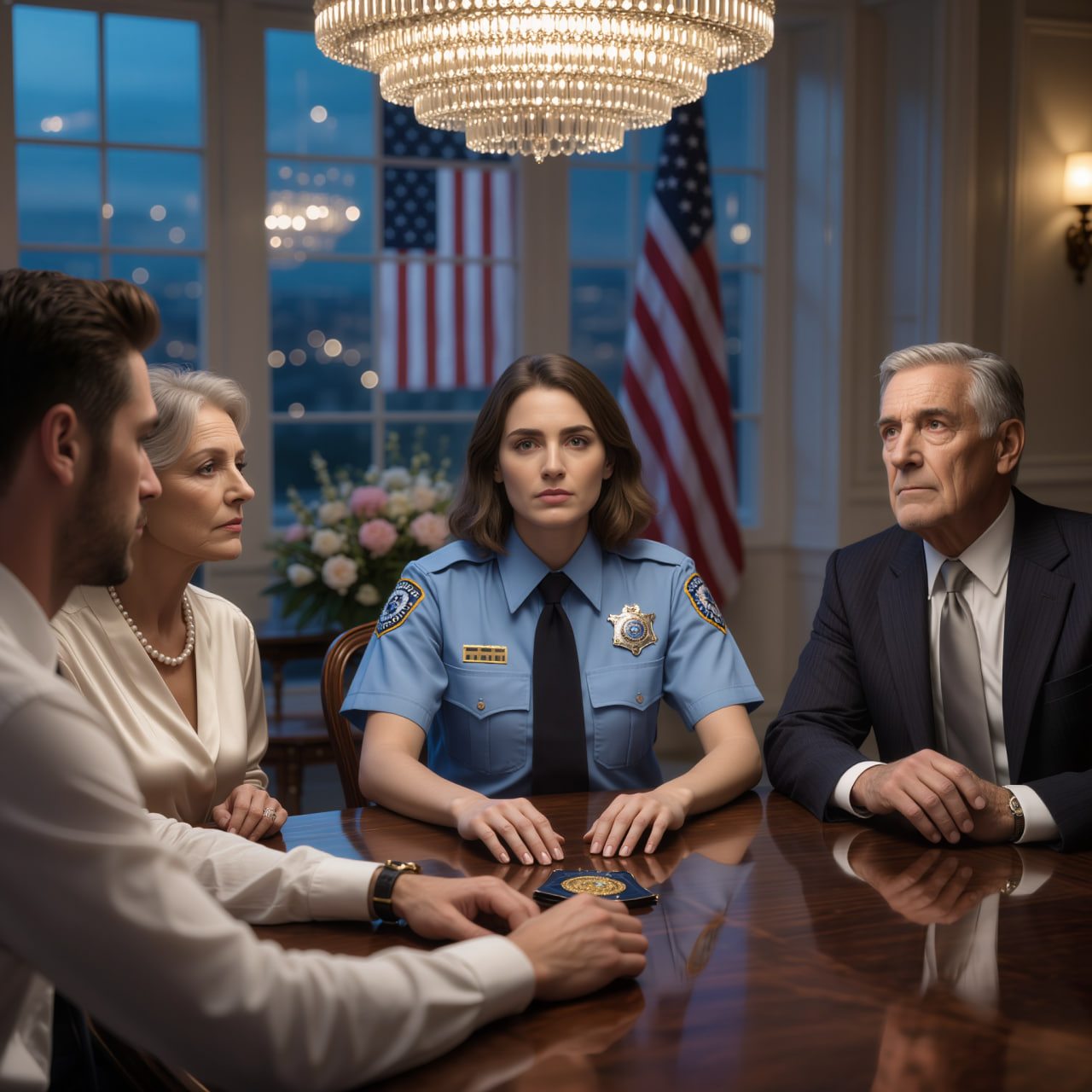
Inside, warmth—physical, not emotional. The air smelled of roasted chicken, lemon polish, and faint perfume. The foyer gleamed: brass fixtures, family portraits in gold frames, a spotless floor you could eat off. Tom and Linda stood side by side near the dining‑room archway like well‑trained hosts greeting a guest they didn’t quite invite. Tom—tall, silver‑haired, the kind of man who carried himself like every room was his boardroom—offered a firm, cool handshake, the handshake of a man taking inventory. Linda’s smile was delicate and practiced, the corners of her lips pulled just a bit too tight.
“So nice to finally meet you, Clare,” she said. “We were starting to think you got lost.”
“Not lost,” I said lightly. “Just delayed—helping a driver. A veteran, actually.”
Her eyebrows lifted slightly. “Oh, how admirable.” The pause before that last word carried a weight I didn’t miss.
Tom gestured toward the table. “Well, let’s not let dinner get cold.”
The dining room was a painting—china plates, crystal glasses, silverware catching candlelight. I set the pastry box near the centerpiece, instantly regretting it when I noticed the homemade pies already arranged perfectly on crystal stands. Linda glanced at my box, then at me.
“Oh, you brought something,” she said. “That’s sweet.” Her tone made me feel like I’d handed her a paper sack at a charity gala.
Evan pulled out my chair and I sat, smoothing my blouse and hoping the faint dust didn’t show under the warm lights.
Conversation started politely, as these things do. Tom asked about my daily routine in a cadence that sounded more like cross‑examination than curiosity.
“Well,” I said, “it depends on the shift. I work mostly days—community patrol, school visits, some traffic enforcement. We focus a lot on education now, preventing issues before they start.”
Linda tilted her head. “That must be so stressful—seeing all that unpleasantness.”
“Sometimes,” I admitted. “But I try to remember most people are good. They just need help at the right moment.”
Tom sliced into his chicken. “Still a dangerous line of work for a young woman. Ever think of something safer?”
I met his gaze evenly. “I think about doing something meaningful. Safety is never guaranteed in any job.”
His knife paused mid‑cut. The silence that followed stretched just long enough to be noticed. Linda changed the subject—traffic lights, community meetings—but every question carried the undertone of Why this life? Why you?
Between courses, I caught my reflection in the polished silver water pitcher. The faint smudge on my sleeve was still there. Linda’s eyes flicked toward it twice. I folded my arm casually to cover it.
Evan tried to smooth things over. “Mom, Dad—Clare was one of the first women in her unit to—”
“Oh, Evan,” Linda interrupted, smiling too brightly. “No work talk at the table. Let’s keep it light.”
Heat rose in my cheeks, but I stayed quiet. Some people don’t believe until life itself forces them to. Years on the job had taught me that silence can speak louder than any defense.
Tom leaned back after dinner, swirling his wine. “So. You’ve been with the force how long?”
“Eight years,” I said.
“Long time,” he murmured. “Do you plan to stay in enforcement after marriage?” The word enforcement hung in the air like something unpleasant.
“I plan to keep serving,” I said. “Whatever that looks like.”
Linda gave a thin smile. “Of course you do.”
Evan shifted, uncomfortable. “Mom—”
“It’s fine,” I said, forcing a small laugh. “I get that question a lot.”
She nodded politely, but her eyes drifted again to my sleeve—as if she could see every late shift and every call that didn’t fit her world.
Dessert was coffee and pie. I didn’t have much of an appetite. I tried small talk; my words felt clumsy in that polished room. When the grandfather clock in the corner chimed seven, I thought it might be time to cut my losses.
Then a sound from outside—faint, then clear: tires on gravel, a car door, low voices. Linda frowned. “Were we expecting someone else?”
Tom shook his head, glancing toward the window. “No.”
I turned toward the sound. My pulse kicked up. I knew that car. I knew that voice.
The knock came in three polite but firm taps—patient, authoritative. Every head at the table turned.
“I’ll get it,” Evan said, half rising.
“No, dear,” Linda said briskly. “It’s probably one of the neighbors.” She glided across the floor, heels whispering against hardwood. In the glass of the dining‑room door, her reflection held perfect composure.
Then she opened the front door—and her composure froze.
Ruth stood framed by the porch light, Navy cap perched neatly on her head, now with a soft cardigan and pearls. Beside her stood a uniformed local officer—hat in hand, expression neutral but respectful.
“Good evening,” the officer said. “Sorry to interrupt. Mrs. Ellison asked to stop by so she could thank someone personally. Says a young lady helped her with a flat tire earlier.”
My chair scraped quietly as I stood. Ruth’s eyes found mine, and her face lit up.
“There you are,” she said warmly, stepping forward. “I told Officer Grady I’d know you the second I saw you. You didn’t even give me your last name, Officer Hayes.”
Linda blinked, bewildered. “You know each other?”
“In a way,” Ruth said, smiling. “She saved me from sitting on that shoulder half the night, changed my tire, refused a dollar, and made sure I got home safe. And when my driver finally caught up, I told him I wanted to come thank her properly.”
Tom stood, confusion shifting to something more guarded. “You’re the woman she stopped for.”
“I am,” Ruth replied. “And you must be her future in‑laws. You should be very proud. It’s not often you meet someone who stops in their nice clothes, on their way somewhere important, to help a stranger in trouble.”
Silence—total for a beat. Linda’s lips parted, but no words came. She turned toward me, surprise and faint embarrassment softening her face.
“You didn’t say it was that kind of situation,” she murmured.
I shrugged lightly. “It didn’t seem like a big deal.”
“That’s exactly what makes it one,” Ruth chuckled. Officer Grady smiled politely.
“Mrs. Ellison insisted we stop,” he said. “Said you reminded her of someone she served with—the kind who does the right thing even when it’s inconvenient.”
“Please come in,” Linda said, stepping aside. “It’s chilly outside.”
Ruth nodded and stepped inside, the officer tipping his hat before leaving. Her presence filled the foyer—calm but commanding—the quiet strength that doesn’t need volume to be felt. She looked around, eyes landing briefly on the family photos along the hallway—smiling faces, summer weddings, lake vacations.
“You have a lovely home,” she said to Linda, who managed a quick, polite thank‑you. “But I must say, this young lady’s kindness tonight was even lovelier.”
I felt my face warm. “Really, it was nothing.”
“Oh, don’t you start,” Ruth said, playful but firm. “You knelt on gravel in a blouse that probably cost more than my groceries for the month. I don’t forget that kind of thing.”
Tom cleared his throat. “You mentioned service, Mrs. Ellison. Were you in the military?”
“Navy Nurse Corps,” she said proudly. “Sixty‑nine to seventy‑four. A year on the USNS Mercy back when women in uniform had to work twice as hard to be taken half as seriously.” She smiled faintly. “Sound familiar, Officer Hayes?”
“More than I’d like to admit,” I said.
Something softened in Tom’s face. He looked from Ruth to me, the faintest trace of humility creeping into his eyes. Linda had gone quiet—the delicate mask of social grace slipping into reflection.
“I’m sorry if we interrupted dinner,” Ruth said, glancing toward the table. “I just wanted to say thank you properly. I’ve been around a long time, and I’ve learned you don’t let good deeds go unspoken. Too many people assume kindness is just a job requirement these days, but what she did wasn’t duty. It was who she is.”
I tried to deflect with humor. “Well, I wasn’t about to let a Navy veteran lose a wheel in the middle of nowhere.”
“That’s exactly the kind of thing my late husband would’ve said,” Ruth laughed softly.
“Mrs. Ellison,” Evan said, stepping forward, smiling, “would you join us for a cup of coffee? We’d be honored.”
Linda’s eyes widened—not at the invitation, but at her son’s tone. He’d never sounded so sure.
“That would be lovely,” Ruth said, resting a hand lightly on his arm. “If it’s no trouble.”
“No trouble at all,” Evan said. “We were just finishing dessert.”
As Ruth joined us at the table, the atmosphere shifted. The tension that had hung like static softened into something gentler, almost reverent. Tom straightened his posture. Linda busied herself fetching another cup, grateful to have something to do. Ruth slid into the chair beside me and gave a conspiratorial smile.
“See,” she whispered, “sometimes being late puts you right on time.”
I chuckled. “I’ll have to remember that one.”
Part 3
See more on the next page
Advertisement
<
See more on the next page
Advertisement
