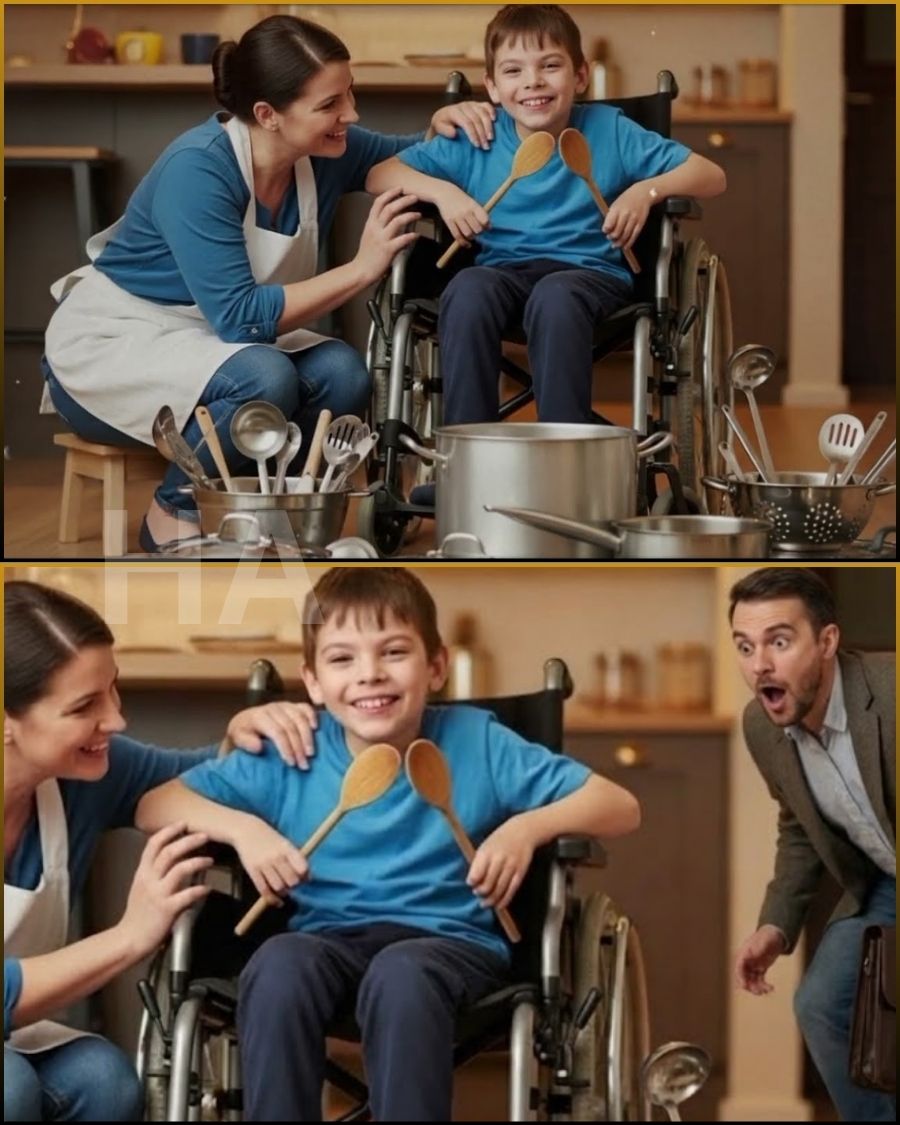
Jonathan asked the usual questions. Experience. Cooking. Comfort with medical schedules. Ability to lift, to assist, to drive.
Elena answered quietly. Competently. No drama.
Then she asked one question.
“Does Lucas like music?”
Jonathan blinked, as if she’d asked whether Lucas preferred thunderstorms or birthdays.
“Music,” he repeated.
Elena nodded. “Some kids do. Some don’t. It matters.”
Jonathan glanced at the resume again. “You play?”
“I listen,” she said. “And I can keep rhythm.”
It was an odd thing to say in an interview for housekeeping. It was also the first human-sounding thing anyone had said to him about Lucas in months.
Jonathan hired her the next day.
He told himself it was because she seemed steady.
He did not realize how badly his home needed steady.
The first week passed uneventfully.
Elena cleaned with a kind of quiet discipline that made the mansion feel less like a showroom and more like a place people lived. She prepared simple meals that smelled like food rather than like a chef’s performance. Soups that didn’t try to impress. Roast chicken that didn’t require a garnish lecture. Scrambled eggs that Lucas actually ate.
Jonathan, buried in calls and late-night meetings, barely crossed paths with her. If he saw her at all, it was as a soft presence in the periphery, moving through rooms like she belonged there without trying to own them.
Lucas noticed her.
He noticed her the way kids notice things adults forget are noticeable. The tone of a voice. The rhythm of footsteps. The difference between someone who comes into a room to manage you and someone who comes into a room to be with you.
Elena hummed when she cooked.
Not a song Jonathan recognized. Just a melody, half-finished, like a sentence that didn’t need punctuation. It floated through the kitchen and into the hallway and down toward the den where Lucas sat most afternoons, his wheelchair parked near the window like he was waiting for something to happen on the lawn.
On Tuesday, Lucas rolled himself into the kitchen and watched Elena slice carrots.
She didn’t turn around immediately.
She didn’t say, “Oh! Lucas!” like he was a surprise obstacle.
She kept slicing, then said, as if they’d been talking all along, “Do you like soup or do you tolerate it?”
Lucas made a face. “Depends.”
“That’s a fair answer.” Elena glanced at him. “What kind depends?”
Lucas hesitated, as if deciding whether he was allowed to have preferences anymore. “Chicken noodle.”
Elena nodded as if he’d delivered a serious policy position. “Then chicken noodle it is.”
Lucas lingered, listening to the hum. His eyes tracked her hands. He asked, finally, “What’s that song?”
Elena smiled a little. Not big. Not forced. “It’s not a song. It’s a door.”
Lucas frowned. “A door to what?”
“To the part of your brain that remembers you are still here,” she said, like that was the most normal sentence in the world.
Lucas rolled away after that, but slower than usual.
On Thursday, he came back.
On Friday, he laughed.
It happened when Elena dropped a wooden spoon into a mixing bowl and it made a ridiculous clonk sound, like a cartoon bonk. Elena froze, looked at the spoon, then at Lucas, and said in a solemn voice, “Your Honor, the spoon has confessed.”
Lucas’s laughter erupted like it had been bottled for months.
It startled Jonathan.
He’d come home early that evening, exhausted and restless, carrying his laptop bag like it weighed more than it should. The sound hit him in the foyer, bright and strange, and he stood still on the marble floor as if laughter might be a fragile thing that could break if you moved too quickly.
He followed it toward the kitchen.
Lucas was there, cheeks flushed, hands resting on his lap. Elena was leaning on the counter with a bowl in front of her, looking at Lucas like he was the only person in the room.
Jonathan’s throat tightened.
He backed away before either of them saw him. He didn’t want his presence to turn the moment into performance.
He went upstairs, sat in his office, and stared at the locked monitor cabinet.
He told himself he didn’t need to look.
Then he opened it anyway.
Not because he expected to catch something wrong.
Because he couldn’t understand what he’d heard.
He powered on the feeds. One screen, then six, then twelve, filling the dark office with quiet little windows of his home. Hallway. Living room. Den. Kitchen. Lucas’s room. The therapy room he’d built and then avoided.
He clicked the living room feed.
Elena was on the floor beside Lucas’s wheelchair.
Not speaking.
Not doing therapy.
Not even touching him.
She was just there, palms resting on the tile, eyes closed. Lucas’s hands were on his armrests, his shoulders high with tension the way they always were when he was bracing for something.
Elena breathed in slowly.
Lucas breathed in.
Elena breathed out.
Lucas breathed out.
Jonathan leaned closer.
It looked like nothing. It looked like waiting.
Then Elena whispered something Jonathan couldn’t hear through the muted audio.
Lucas’s shoulders dropped, not all at once, but as if he’d been carrying a backpack of rocks and someone had quietly unbuckled it.
Elena tapped her fingertips on the tile. Softly. A rhythm so gentle it barely registered. Then she reached into a cloth bag and pulled out two wooden spoons.
She held them out.
Lucas stared at them, suspicious.
Elena tapped the spoons together once. A clean, simple click.
Lucas hesitated, then took them.
His hands were small and pale against the wood. He lifted the spoons and tapped them together. The sound was clumsy.
Elena tapped back. Same rhythm. Same steadiness.
Again.
Again.
A pattern formed, awkward at first, then steadier, like two people learning a language by repeating the same sentence until it stopped feeling foreign.
Lucas’s mouth twitched, trying to remember how to become a smile.
Then he laughed.
The camera’s audio caught it, sharp and real.
Jonathan froze in his chair.
It wasn’t in any care manual.
It wasn’t therapy or routine.
It was connection, made from nothing but attention.
Jonathan clicked to a later timestamp.
Elena adjusted Lucas’s blanket with a slow care that looked more like reverence than duty. She tucked it around his legs, smoothing fabric that Lucas couldn’t feel, but somehow he watched like he could.
She spoke to him. Not baby talk. Not “good job” like he was a pet doing tricks.
As if he were a person with a whole interior world.
“You don’t have to be brave all the time,” she said softly. “You can be tired. I’ll stay.”
Jonathan’s chest tightened like someone had cinched a strap around his ribs.
He watched more.
Over the next days, he found himself returning to the feeds at odd hours. Not for fear. For something he couldn’t name.
He saw Elena read to Lucas, not from children’s books, but from adventure novels. She paused and asked, “Would you go into the cave?”
Lucas frowned. “No.”
Elena pretended to be scandalized. “So you’d let the treasure just sit there?”
“It’s a trap,” Lucas muttered.
Elena nodded as if he’d uncovered a conspiracy. “Smart. How would you avoid it?”
Lucas leaned forward, engaged. He started talking, really talking, mapping strategies. For ten minutes he forgot his chair existed.
Jonathan watched, throat burning.
He saw Elena guide Lucas through exercises after the physical therapist left. Not as punishment. As a game.
“Okay,” she said one afternoon, holding up a towel. “This is the dragon’s tail. If you can grab it, you are officially knighted.”
Lucas rolled his eyes. “That’s dumb.”
Elena whispered loudly, “He says it’s dumb because he’s scared.”
Lucas glared. “I am not.”
“Prove it,” Elena challenged, and Lucas reached, strained, grabbed, and when he succeeded, Elena bowed like he’d saved a kingdom.
Lucas grinned, breathless. “I’m not a knight.”
“Fine,” Elena said. “Then you’re the dragon.”
Lucas snorted. “Dragons don’t do towels.”
“These dragons do,” Elena replied.
Jonathan turned away from the screen, wiping his eyes with the heel of his hand like he could scrub emotion off his face.
He told himself he was just tired.
He was not just tired.
He was watching someone give his son something Jonathan had not known how to deliver: permission to still be alive inside his own body.
The moment that shattered Jonathan’s assumptions came late one night.
The house was quiet. Jonathan was in his office, laptop open, staring at numbers that refused to hold his attention. He checked the feeds almost without thinking.
The living room camera showed Lucas alone in his wheelchair.
The lamp was off. Only the glow from the fireplace screen saver flickered across the walls. Lucas’s face was wet. His fists were clenched like he was trying to keep himself from breaking in half.
Jonathan’s heart lurched. He grabbed the armrest of his chair, half-rising.
Lucas’s mouth moved, and the camera’s audio, low but clear, caught his voice.
“I hate this chair,” Lucas sobbed. “I hate being stuck.”
Jonathan’s instinct screamed go. Run down, scoop him up, say something that would fix it.
But Jonathan had tried words before. Words like you’re strong and you’re still you and we’ll figure it out.
They had sounded like someone knocking on a locked door with the wrong key.
He hesitated, compelled to watch, horrified by himself for it.
Elena entered the frame, moving quickly but not panicked. She knelt in front of Lucas, her face level with his.
She didn’t tell him to stop crying.
She didn’t rush to brighten the moment.
She said, simply, “I know.”
The words landed like a hand on a fevered forehead.
Lucas blinked at her as if shocked someone had agreed with his pain instead of trying to argue it into submission.
Elena took Lucas’s hands gently and placed them on her own legs.
Lucas stiffened, confused. “What are you doing?”
“Tell me what you miss,” Elena said.
Lucas swallowed. His voice came out small. “Running.”
Elena nodded, and Jonathan’s stomach dropped because he saw where she was going and it terrified him in a way he couldn’t explain.
She moved Lucas’s hands from her thighs to her knees.
“Then feel this,” she said. “This is movement. Different doesn’t mean gone.”
She stood up slowly, keeping Lucas’s hands on her knees so he could feel the shift of muscles beneath skin. She walked in place, gentle steps, and narrated it like she was inviting Lucas into a world he’d been barred from.
“Weight moves here,” she said softly. “Knee bends. Foot lifts. The floor pushes back. One. Two. Three.”
Lucas’s breathing slowed. His eyes fixed on her face, not her legs, like he was trying to memorize the map she was giving him.
When she stopped, she knelt again, hands still holding his.
See more on the next page
Advertisement
