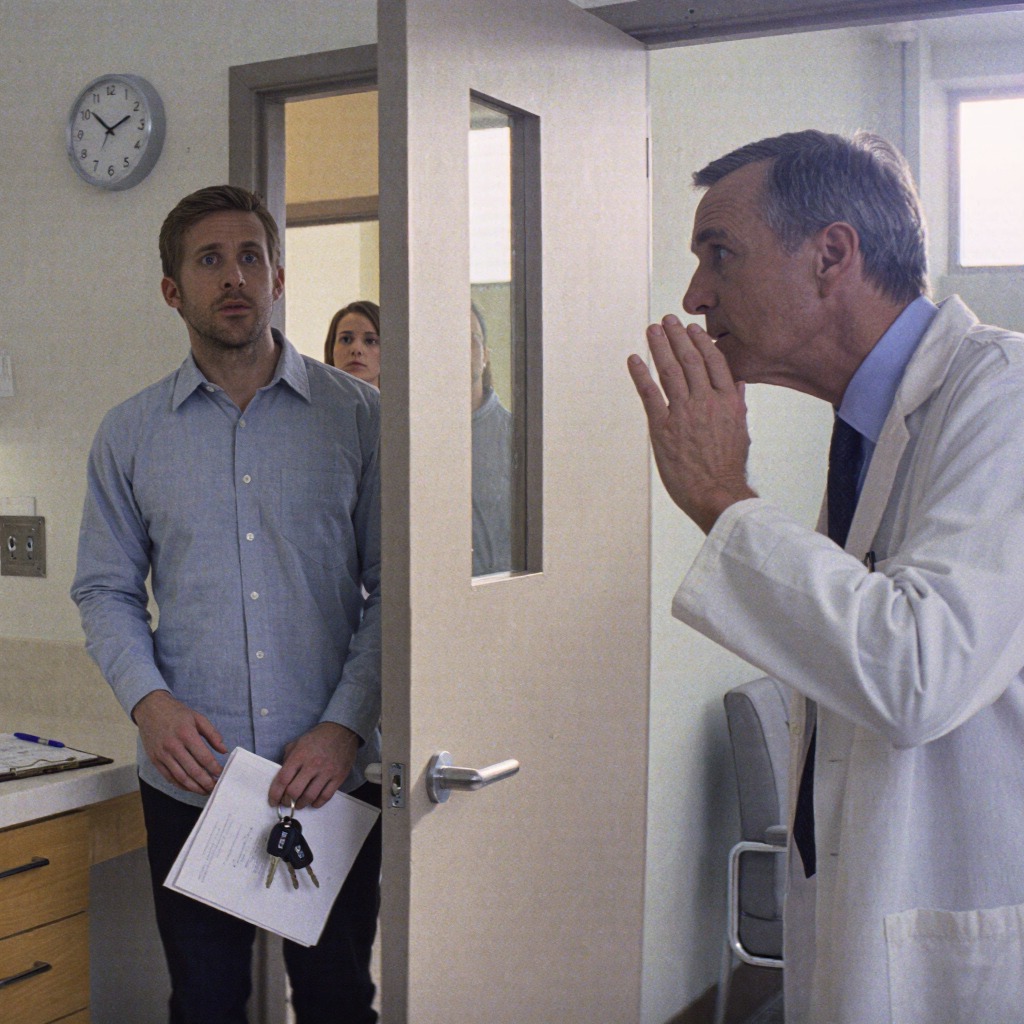
The drive to urgent care was twenty minutes that felt like an hour.
Sarah stared out the passenger window, fingers twisting in her lap like she was wringing herself out. Every time I tried to talk, her answers were short and dead.
“How’s that logo project going?” I asked.
“Fine.”
“Want Chinese tonight? Or we can do pasta.”
“Whatever.”
“Hey,” I said, trying to keep my voice soft, “we can still go to Michigan next month. Just… after we figure this out.”
“Sure,” she said, the word empty.
At a stoplight, I reached over and touched her hand.
She flinched.
A real flinch—shoulders up, hand jerking away like I’d touched a bruise.
“Sorry,” she whispered. “Just jumpy.”
But she tucked her hand under her thigh where I couldn’t reach it.
I stared ahead, pretending I hadn’t seen that.
Because seeing it meant admitting something was really wrong.
The waiting room at Lakeside Urgent Care smelled like antiseptic and stale coffee. Fluorescent lights hummed. A kid with a bloody nose sat across from us while his mom pressed tissues to his face. CNN played on mute on the wall.
Sarah filled out intake forms slowly: name, date of birth, insurance, medical history.
When the receptionist called her up to hand over her ID, I watched closely.
The receptionist glanced at the license, typed something, then paused. Just for a second. Her fingers hovered over the keyboard like she’d hit a pothole.
Then she typed faster, returned the ID, and smiled like nothing happened.
“The nurse will call you shortly.”
Sarah sat down beside me and stared at the TV ticker scrolling across the bottom of the screen. But her eyes didn’t track the words left to right. They just… stayed fixed, like she was staring through it.
“Sarah,” I whispered. “Whatever this is, we’ll figure it out.”
“Okay,” she said, nodding once.
Mechanical.
Fifteen minutes later, a nurse called her name.
Sarah stood like she was moving through water.
I followed her down a hallway lined with exam rooms.
Room 4.
The nurse—young, tired-looking, name tag: Jennifer K.—took vitals.
Temperature 98.4.
Blood pressure 128/84.
Pulse 92.
“A little elevated,” she noted, “but not concerning. Doctor will be in shortly.”
Then she left.
Sarah sat on the exam table. Paper crinkled under her. Her hands gripped the edge like she might fall.
I sat in a plastic chair against the wall.
“See?” I said softly. “Not too bad.”
Sarah didn’t respond.
A knock.
The door opened.
A woman in a white coat stepped inside—mid-forties, dark hair pulled back, sharp brown eyes behind wire-rimmed glasses.
Name tag: Dr. Anukica Patel, MD. Internal Medicine. 18 years.
“Sarah,” Dr. Patel said calmly, extending a hand.
Sarah shook it. Her grip was limp.
Dr. Patel sat on a rolling stool, opened Sarah’s chart.
“Tell me what’s been going on.”
Sarah’s answers sounded rehearsed. Flat.
“I’ve been tired. Not sleeping well. Stomach’s been off.”
“Any nausea? Dizziness?” Dr. Patel asked.
“Just tired.”
Dr. Patel studied her like she was reading between the lines.
“Your husband mentioned you’ve been withdrawn,” she said.
Sarah shot me a quick look. Sharp.
“He worries too much,” Sarah replied.
Dr. Patel nodded once. “Fair enough.”
She pulled out her stethoscope.
“Let me listen to your heart and lungs.”
Sarah lifted her shirt slightly. Dr. Patel listened, moved the stethoscope to Sarah’s back.
“Deep breath.”
Sarah complied.
Again.
Again.
Dr. Patel’s expression stayed professional, but I saw something flicker in her eyes. Not alarm. Not confusion.
Recognition.
“All clear,” Dr. Patel said.
Then, casually: “Roll up your left sleeve for me. I want to check your blood pressure manually.”
Sarah hesitated—barely half a second.
Then she pushed her sleeve up to her elbow.
Dr. Patel wrapped the cuff around her arm, pumped it, watched the gauge.
But her eyes weren’t on the numbers.
They were on Sarah’s forearm.
On a small faded tattoo—a compass rose about an inch wide.
Dr. Patel’s jaw tightened, then smoothed like she’d trained herself not to react.
“Blood pressure looks good,” she said, removing the cuff.
She rolled back slightly.
“I’d like to run some blood work. Full panel. Thyroid, anemia, vitamin deficiencies.”
“That’s it?” Sarah asked, too fast.
“That’s it,” Dr. Patel said, standing. She opened the door. “Jennifer, can you take Ms. Carter to the lab?”
Jennifer appeared. “Of course.”
Dr. Patel smiled at Sarah. “This won’t take long.”
Then she turned to me, voice lowering half an octave.
“Daniel, could I speak with you alone for a moment? A few questions about Sarah’s medical history.”
Sarah’s eyes snapped to me.
“Why alone?”
“Routine,” Dr. Patel said smoothly. “Partners often notice things patients don’t report.”
Sarah frowned, but Jennifer was already guiding her out.
The second Sarah turned the corner, Dr. Patel grabbed my wrist hard.
Not gently. Not politely.
Hard.
She pulled me into a small office across the hall, shut the door, and locked it.
The calm doctor vanished.
“You need to leave,” she whispered. “Now. Walk out the side exit. Don’t go back. Don’t let her see you leaving.”
My heart slammed into my ribs.
“What? Why? Is she dying?”
“No,” Dr. Patel said sharply. “This isn’t about her health.”
She pulled out her phone with shaking fingers.
“It’s about who she is.”
“I don’t understand.”
Dr. Patel scrolled fast, then turned her phone to face me.
An old patient photo loaded.
A woman with Sarah’s bone structure. Sarah’s eyes. Different hair. Harder expression.
“That’s not Sarah,” I whispered automatically, because my brain needed to reject it.
“No,” Dr. Patel said. “That’s Maya Brennan. She escaped during prisoner transport. They never caught her.”
The room tilted.
“That’s impossible,” I said.
Dr. Patel’s voice shook. “Three years ago, I worked an ER shift at Cook County Memorial. Maya Brennan came in under police custody for assault. She had a surgical scar across her lower left ribs, an old wrist fracture that healed wrong, and a compass rose tattoo on her left forearm.”
My mouth went dry.
“Check her ribs,” Dr. Patel whispered. “Roll up her shirt. I saw the scar when I listened to her lungs.”
From down the hall, Sarah’s voice cut through the door.
“Daniel? Where are you?”
The doorknob rattled.
Dr. Patel’s face went white.
“If she realizes I recognized her—” Dr. Patel swallowed. “She could panic. She’s considered dangerous.”
The knob rattled harder.
“Daniel!”
Dr. Patel shoved me toward a second door I hadn’t even noticed.
It opened into a supply closet.
“Go through the staff hallway,” she hissed. “Exit by the pharmacy. Run.”
“I can’t just—”
“She could hurt you,” Dr. Patel said, eyes wide. “Or me. Or anyone here. Please.”
The knob rattled again.
I didn’t think.
I moved.
3
The staff hallway smelled like bleach and pressure. Nurses turned as I pushed through doors marked AUTHORIZED PERSONNEL ONLY.
My heart hammered so hard I felt it in my throat.
I hit another door and burst into the parking lot.
Cold October air hit my lungs like ice water.
Behind me, a door banged open.
Footsteps.
Fast.
I ducked between two SUVs and pressed myself against cold metal, trying to make my body smaller than fear.
My fingers shook as I pulled out my phone.
“911, what’s your emergency?”
“My wife—” My voice cracked. I swallowed hard and tried again. “A doctor just told me my wife might be an escaped prisoner. I’m at Lakeside Urgent Care on Ogden Avenue in Naperville. She’s inside. I think she’s dangerous.”
“Sir, are you in immediate danger?”
“I don’t know,” I whispered. “I’m hiding in the parking lot.”
I paused, listening.
Footsteps—slower now. Controlled.
I peeked through the SUV window.
Sarah had emerged from the building.
But it wasn’t the withdrawn, hollow Sarah from the couch.
Her shoulders were squared. Her head moved in smooth sweeps, scanning. Her posture was confident, alert—like someone trained to locate threats.
Like someone who’d run before.
“Sir,” the dispatcher said. “Do you see her?”
“She’s outside,” I whispered. “She’s looking for me.”
“Police are en route. Approximately four minutes. Can you stay hidden?”
“I think so.”
Sarah walked toward our Honda Accord, tried the handle. Locked. She pressed her face to the window and peered inside. Then she straightened and scanned the lot again.
Her eyes passed over the SUVs.
Kept moving.
Then snapped back.
And she started walking toward me.
Not running. Walking.
Like she had all the time in the world.
My blood turned to ice.
“She’s coming toward me,” I whispered.
“Can you move to another location?”
“If I move, she’ll see me.”
Sarah was thirty feet away.
Twenty-five.
Twenty.
And then—like a miracle made of engine noise—a patrol car whipped into the lot with lights flashing. Another behind it.
Sarah froze.
For a split second her face cracked—not fear, not shock.
Calculation.
Fast math.
Then she turned and jogged toward the far side of the building.
Two officers jumped out and sprinted after her.
Someone touched my shoulder.
I jerked so hard my head slammed into the SUV mirror.
Pain flashed.
Dr. Patel crouched beside me, breathing hard.
“I’m sorry,” she whispered. “I tried to stall her in the lab, but she realized I separated you.”
“What happens now?” My voice didn’t sound like mine.
“Now you tell them everything,” she said.
They caught her eleven minutes later.
She tried to slip through the urgent care’s back exit into the strip mall lot behind it. Officers had already circled.
She ran.
Made it maybe fifty yards before three officers tackled her.
She fought like an animal.
Screaming, twisting, kicking.
It took all three to get cuffs on her, and she didn’t cry.
She raged.
Like being caught was an insult.
I stood in the parking lot shaking so hard my teeth clicked and stared at the woman being shoved into the back of a cruiser.
My wife.
Or… not my wife.
A stranger wearing my wife’s face.
A fugitive.
A lie.
The dispatcher asked if I was safe. I said yes. My mouth said yes.
My body didn’t believe it.
4
See more on the next page
Advertisement
<
See more on the next page
Advertisement
