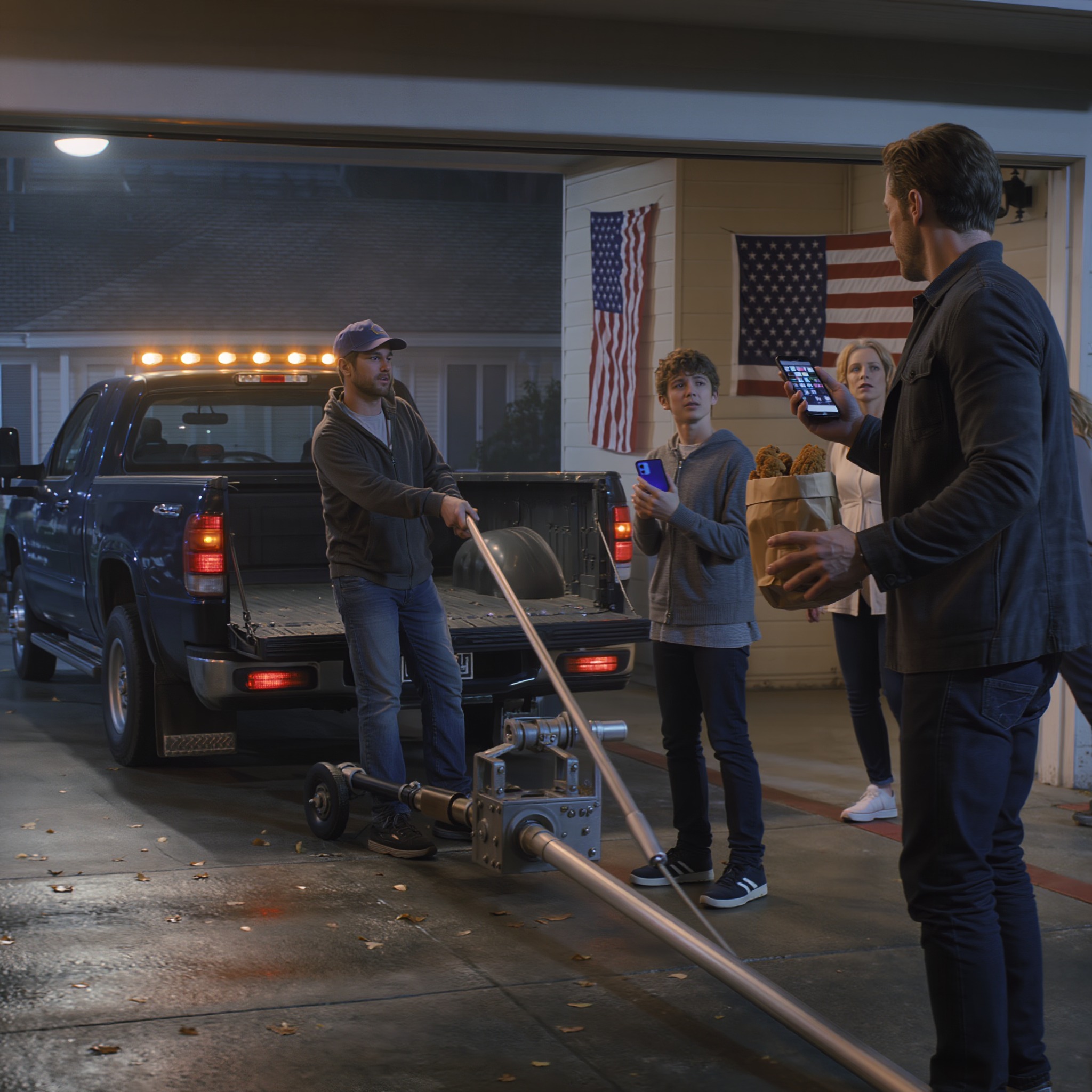
She didn’t look at me.
“You scared us,” she said quietly.
Trevor smirked. “Yeah, Thomas. You’ve been acting weird lately.”
The officer raised a hand.
“Let’s keep this respectful.”
I answered their questions again. Same facts. Same timeline. I could feel Trevor watching me, waiting for me to slip.
Then he spoke, voice wounded.
“My stepdad hates me. He’s been trying to get me out of the house for months.”
“That’s not true,” I said.
Deborah finally looked up.
“You said he needed to move out.”
“I said he needed a plan,” I replied. “He’s 32.”
The officer scribbled notes.
When they left, Deborah stood and pointed toward the door.
“You shouldn’t be here.”
I laughed once—short and ugly.
“You planned my funeral.”
Her face went pale.
“You’re sick,” she whispered.
I walked out before I said something I couldn’t take back.
That afternoon, I sat alone in a cheap motel off I-26, watching the parking lot through the blinds. Every set of headlights made my shoulders tense. The room smelled like stale cigarettes and pine. The bedspread had a pattern that might have been flowers once. A TV bolted to the dresser played local news on mute.
My phone sat on the nightstand, screen dark. I turned off notifications hours ago, but I could still feel them—messages piling up like snow.
I picked it up finally, opened Facebook. Deborah’s post had been shared 43 times. The Hendersonville community page had its own thread going.
Prayers for the Bennett family during this difficult time. Rumors are flying and it’s heartbreaking.
Someone had commented: We stand with you, Deborah.
I stared at that line. The town had picked a side and it wasn’t mine.
I scrolled through the comments. Most were supportive of Deborah. A few were cautious—let’s wait for all the facts—but those were buried under the avalanche.
One comment stopped me cold.
Thomas Bennett always seemed off to me, too quiet. You never know with those types.
I’d helped that woman carry groceries once when her husband was in the hospital.
I set the phone down.
In a small town, your reputation is currency, and mine was tanking fast. The thing about a lie is that it doesn’t need to be big. It just needs to be first. Deborah had gotten her story out while I was still trying to figure out how to survive the night.
Now I was the unstable husband. The paranoid stepdad. The man who couldn’t handle his own house falling apart.
And Trevor—Trevor was the victim. The misunderstood son.
It was a good story. Clean. Simple. Easy to believe.
The truth was messy. Complicated. It required people to imagine that a wife and stepson could be cold enough to plan a murder, that a brake line could be cut deliberately, that the smiling family in the Christmas photo could be something else entirely.
Most people don’t want to imagine that. It’s easier to believe I’m the problem.
I thought about calling my daughter Sarah. She lived two states over, had her own family. We talked every few months, kept it light. I hadn’t told her about the tension with Deborah and Trevor. Now I wondered if that had been a mistake.
But what would I even say?
Hey honey, your stepmother and stepbrother tried to kill me. How are the kids?
I left the phone on the nightstand.
The motel had thin walls. I could hear a couple arguing next door—voices rising and falling. A truck rumbled past on the interstate, Jake brakes hissing. I got up and checked the door lock, then checked it again. Then I pulled a chair over and wedged it under the handle. It probably wouldn’t stop anyone determined, but it made me feel slightly less exposed.
I sat back down and looked at my hands. They were steadier than last night, but I could still see the tremor if I held them flat.
Patience is my tool.
I’d said that to myself a hundred times since the garage. But patience was getting harder to hold on to because patience required faith that things would work themselves out. And right now it didn’t feel like the truth was winning.
My phone buzzed.
A text from Eugene.
You holding up?
I typed back: Yeah. Thanks for last night.
A pause. Then:
Police came by again. Talked to the neighbors. One guy saw Trevor in your garage late that night. Another heard tools.
My pulse jumped.
They told you that?
He wrote back: Told me they’re building a timeline.
I set the phone down and exhaled slowly.
A timeline. Evidence. Witnesses.
Small pieces, but pieces.
I pulled the scratchy motel blanket over my legs and leaned back against the headboard. The TV was still on mute. Some commercial for car insurance. A happy family loading up for a road trip, golden retriever in the back seat.
I grabbed the remote and turned it off.
Outside, another set of headlights swept across the parking lot. I tensed, watching through the gap in the blinds until the car kept going. Then I closed my eyes and tried to remember what normal felt like.
I couldn’t.
The motel room became my world for the next 36 hours. I didn’t leave except to grab vending machine coffee and a sandwich from the gas station next door. The clerk looked at me like I was trouble waiting to happen.
Maybe I was.
Back in the room, I sat on the edge of the bed and stared at my phone. Trevor’s voicemail sat there like a stone in my gut. I’d been avoiding it since Eugene’s garage.
Now I couldn’t put it off anymore.
I pressed play.
“Thomas.” His voice was smooth, easy, like he was calling to ask about borrowing the lawn mower. “You really messed up this time. Dad’s upset. Mom’s upset. You didn’t have to do this. We could have talked.”
I sat there, phone pressed to my ear, barely breathing.
Dad’s upset. Mom’s upset.
He’d never called Deborah mom around me. Not once in eleven years. It was always Deborah, or she, or nothing at all. Like acknowledging her as his mother in front of me would give me too much ground.
But now—now she was mom. Now they were a united front and I was the outsider who disrupted the family.
The voicemail continued.
“Look, I don’t know what you think you heard, but you’re wrong. And this whole thing with the truck—come on, man. That’s just paranoid.”
His tone wasn’t angry. It wasn’t defensive.
It was annoyed. Like I was a kid who’d broken curfew and now he had to deal with the fallout.
“Anyway,” Trevor said, sighing like he was doing me a favor, “call me when you’re ready to talk like adults. We can work this out.”
The voicemail ended.
I sat there for a long time staring at the wall. Then I forwarded it to Elizabeth Garrett with a message: Listen to this. Especially the tone.
Her response came back ten minutes later.
Good. This helps. Intent in tone. He’s not surprised—he’s annoyed. Save everything. Document everything.
I set the phone down and rubbed my face.
Trevor wasn’t panicking. He wasn’t scrambling to cover his tracks or claim innocence. He was irritated that I’d thrown a wrench in his plans.
That scared me more than anything else because it meant he still thought he could control this, that he could smooth it over, play the victim, and come out clean on the other side.
And maybe he could.
I’d seen it before. People who lied so smoothly that the truth started to look like the problem. People who could twist a story until you questioned your own memory.
Trevor had been doing that his whole life.
The room felt smaller suddenly, the walls too close. I stood and paced three steps one way, three steps back. The carpet was worn thin in a path between the bed and the bathroom like a hundred other people had done the same thing.
I thought about calling Deborah. Not to explain. Not to argue. Just to hear her voice and know if there was anything left of the woman I’d married. If there was any part of her that felt guilt or doubt or fear.
But I didn’t. Because I already knew the answer.
She’d made her choice the moment she asked Trevor if he was sure. The moment she exhaled in relief. The moment she didn’t stop him. She’d chosen him.
And I was the problem that needed to be removed.
I walked to the window and pulled the curtain back an inch. The parking lot was half empty. A pickup truck with a camper shell. A sedan with out-of-state plates. A guy in a Carhartt jacket loading bags into his trunk. Normal people doing normal things.
I let the curtain fall and sat back down.
My phone buzzed. A text from an unknown number.
You’re making this worse for everyone.
I stared at it. Trevor. Deborah. Someone else.
I didn’t reply. I just screenshot it and sent it to Elizabeth.
Her response was immediate.
Do not engage. Let them talk. Everything they say is evidence.
Another text came through. Same unknown number.
People are asking questions. You need to fix this.
Then another.
You can’t hide forever.
My chest tightened.
I turned the phone face down on the nightstand and tried to breathe. They were testing me, pushing to see if I’d crack, if I’d reply, if I’d give them something they could twist.
I wouldn’t.
Patience is my tool.
But God, it was hard.
The hours crawled. I tried to sleep, but couldn’t. Every sound outside the door made my heart race. A vacuum cleaner down the hall. A door slamming. Voices passing by. I kept the chair wedged under the handle.
By the time morning came, I felt like I’d aged a year.
I made instant coffee with the room’s tiny kettle and sat by the window, watching the sun come up over the interstate. The sky went from black to gray to pale gold, and the traffic picked up—people heading to work, to school, to wherever their normal lives took them.
I missed normal.
I missed waking up and not checking the locks. Missed walking into a room without calculating exits. Missed trusting that the people in my house weren’t planning my death.
My phone rang. I picked it up expecting another unknown number.
But it was Stanley Coleman.
Stanley and I had worked together for years before his knees gave out and he retired early. Good guy. Solid. The kind of person who showed up when you needed help moving furniture or jumpstarting a car. I hadn’t talked to him since this whole thing started.
I answered.
“Stanley.”
“Thomas,” he said. His voice was careful. “You doing okay?”
“I’ve been better.”
“Yeah. I heard some things. Wanted to check in.”
I closed my eyes. At least one person in this town didn’t think I was crazy.
“Thanks,” I said. “I appreciate it.”
There was a pause. Then Stanley said, “Thomas, I’ve got something you need to hear.”
My pulse kicked.
“What is it?”
“Not over the phone,” he said. “But it’s good. Or at least it’s useful. When can we meet?”
I looked around the motel room—the unmade bed, the chair under the door, the curtains I hadn’t opened all the way in a day and a half.
“Now,” I said. “Where?”
“There’s a diner off exit 9. You know the one?”
“Yeah. I’ll be there in 20.”
He hung up.
I stood, grabbed my jacket, and checked the peephole before opening the door. The hallway was empty. I stepped out, locked the door behind me, and walked fast toward the parking lot.
For the first time in two days, I felt something besides fear.
I felt hope.
The diner off exit 9 smelled like bacon grease and burnt coffee. It was the kind of place where truckers stop at 4 in the morning, and the waitress knows everyone’s order before they sit down.
Stanley was already in a back booth when I walked in. He looked older than I remembered—more gray in his beard, deeper lines around his eyes—but his handshake was still firm.
“You look like hell,” he said.
“Feel worse.”
He nodded toward the coffee pot on the table.
“Help yourself.”
I poured a cup and wrapped my hands around it. The warmth felt good.
Stanley leaned forward, voice low.
“I did some digging after you told me what happened. Nothing official. Just asking around. You know how it is.”
I nodded.
“There’s an AutoZone on Spartanburg Highway. Trevor used to hang around there sometimes when he was working on that Mustang a few years back. I figured it was worth a shot.”
My pulse picked up.
“And the store manager’s a guy I know from church. I explained I was helping with an investigation—kept it vague—and asked if I could look at their security footage from last week.”
Stanley pulled out his phone and set it on the table between us.
“They’ve got cameras on every register. Date and time stamped.”
He tapped the screen. A grainy video started playing. The angle was from above, looking down at the checkout counter. A kid in an AutoZone vest was scanning items.
Then Trevor stepped into frame.
I leaned closer. Trevor looked casual. Relaxed. Hoodie and jeans. Hands in his pockets while he waited. The kid scanned something. I couldn’t see what from the angle. Trevor pulled out his wallet.
Stanley paused the video and zoomed in on the register screen.
“Tubing cutter,” he said. “$28.99. Purchased two days before you overheard him in the garage.”
My throat went dry.
Stanley let the video play. Trevor paid, took his bag, and walked out of frame.
“That’s not all,” Stanley said. He fast-forwarded. The timestamp jumped ahead ten minutes.
Then Deborah walked into frame.
I felt like I’d been punched in the stomach.
She was at a different register—the one on the left side of the store. Purse over her shoulder. Looking down at her phone while the cashier rang up her items. I couldn’t see what she bought, but it didn’t matter. She was there ten minutes after Trevor.
Stanley paused the video again.
“She paid cash,” he said. “No credit card trail. But the time stamp doesn’t lie.”
I stared at the frozen image of my wife standing in an auto parts store ten minutes after my stepson bought a tool to cut my brake line.
“She knew,” I whispered.
Stanley nodded slowly.
“Yeah,” he said. “She knew.”
I sat back in the booth trying to process it. Part of me had still been holding on to the possibility that Deborah had been manipulated. That Trevor had lied to her. That she didn’t understand what she was agreeing to when she asked if he was sure.
But this wasn’t manipulation.
This was coordination.
She’d followed him to the store, bought something—probably supplies, probably something to clean up or cover tracks—paid cash so there wouldn’t be a paper trail.
She’d been part of it from the beginning.
“I’m sorry, man,” Stanley said quietly.
I didn’t know what to say, so I just nodded.
Stanley reached across the table and squeezed my shoulder once. Then he picked up his phone.
“I made copies of the footage,” he said. “Sent them to myself. You’ll want to get this to your lawyer and the police.”
“Yeah,” I said. My voice came out rough. “Yeah, I will.”
“There’s more,” Stanley said. “The store manager said a couple of other people came in asking questions. Detectives, I think. So the police are already looking into it.”
That made me sit up straighter.
“They are?”
See more on the next page
Advertisement
