I answered in my tiredest voice. “Hello?”
“Harold!” she said, bright and sweet. “How are you feeling? How’s Lucas?”
I let silence stretch too long.
“Lucas,” I said slowly. “Oh… yes. Good boy. Quiet.”
Amber laughed softly like that pleased her. “Have you been eating properly?”
I let my voice wobble. “I think so. I can’t remember if I gave the boy lunch today… did I?”
Across the table, Lucas gave me a thumbs up.
“Oh my,” Amber said, and I heard satisfaction leak through the sweetness. “That does sound concerning.”
“I’ve been so tired,” I murmured. “Keep thinking I see Mary in the garden.”
Amber’s voice sharpened for half a second, then smoothed again. “Oh, Harold. Grief can do that.”
“What day is it?” I asked, like the question hurt.
“It’s Thursday,” she said, gentle as poison. “Thursday evening.”
“Thursday,” I repeated. “Right.”
Then, like a knife sliding in, she asked, “Have you been drinking your tea?”
I lowered my head so she could hear the fake defeat. “Yes. The tea. Helps me sleep.”
“That’s very important,” Amber said, and the pleasure in her voice made my skin crawl. “Consistency matters.”
She started talking about “options,” about “care,” about how maybe when they got back they should “discuss professional help.”
I made vague agreeable sounds.
When I hung up, I dropped the act immediately.
Lucas stared at me, eyes wide. “She believed it.”
“Eight years you stayed silent,” I said. “I can act confused for two days.”
Friday morning, Mark called with the results.
His voice was tight. “Harold… there are sedatives in your blood. Prescription-level. Also antihistamines in high concentrations. And a sleep medication that isn’t on your chart.”
I closed my eyes.
It was real.
Not paranoia. Not grief. Not age.
Poison.
“Mark,” I said quietly, “I know who did it.”
“Call the police,” he snapped. “Now.”
“I will,” I promised. “But I need twenty-four hours.”
Silence. Then Mark exhaled like a man watching someone step into danger.
“Twenty-four,” he said. “Not a minute more.”
Saturday felt like the longest day of my life.
We rehearsed again and again. Lucas practiced moving to the bookshelf, grabbing the recorder, speaking clearly. Every time he hesitated, I reminded him:
“You’ve already been brave for eight years. One more day.”
That night, Lucas couldn’t eat dinner. His stomach was twisted with nerves.
I told him stories from Vietnam—not the gore, not the worst parts. The parts about boys younger than my son who found courage when the world demanded it.
At bedtime, Lucas looked up from his pillow.
“Grandpa,” he whispered, “what if everything goes wrong tomorrow?”
I sat on the edge of his bed and smoothed his hair back.
“Then we adapt,” I said. “But it won’t. The truth is on our side.”
Lucas fell asleep fitfully.
I didn’t sleep at all.
I sat in my chair staring at Mary’s photograph and thinking about what grief had taught me: you can survive losing someone and still lose yourself slowly if you stop paying attention.
Sunday afternoon, at 2:00, I heard Christopher’s car pull into the driveway.
Something snapped into place in my body—the hyperfocused calm before an ambush. I hadn’t felt it since 1968.
Lucas and I exchanged one glance across the living room.
His eyes were steady.
Ready.
I slumped in my armchair, shirt buttoned wrong, hair uncombed. I skipped shaving. I made myself look like the man Amber wanted—weak, confused, fading.
Lucas sat on the floor with action figures arranged around him. He went still. Silent. The role he’d played for eight years.
The front door opened.
“Harold! We’re home!” Amber’s voice rang through the house, bright as a commercial.
She stepped into the living room doorway, tanned from the Caribbean sun. Her eyes swept over me, taking inventory.
For a split second, irritation flickered—surprise that I was still upright.
Then her face rearranged into concern.
“Oh, Harold,” she cooed. “You poor thing. You look exhausted. Have you been taking care of yourself?”
I let my gaze drift like focusing was difficult. “Amber… you’re back. Was it… how long…”
“Four days,” she said, sweet. “Just four days.”
“Four,” I repeated slowly. “Right.”
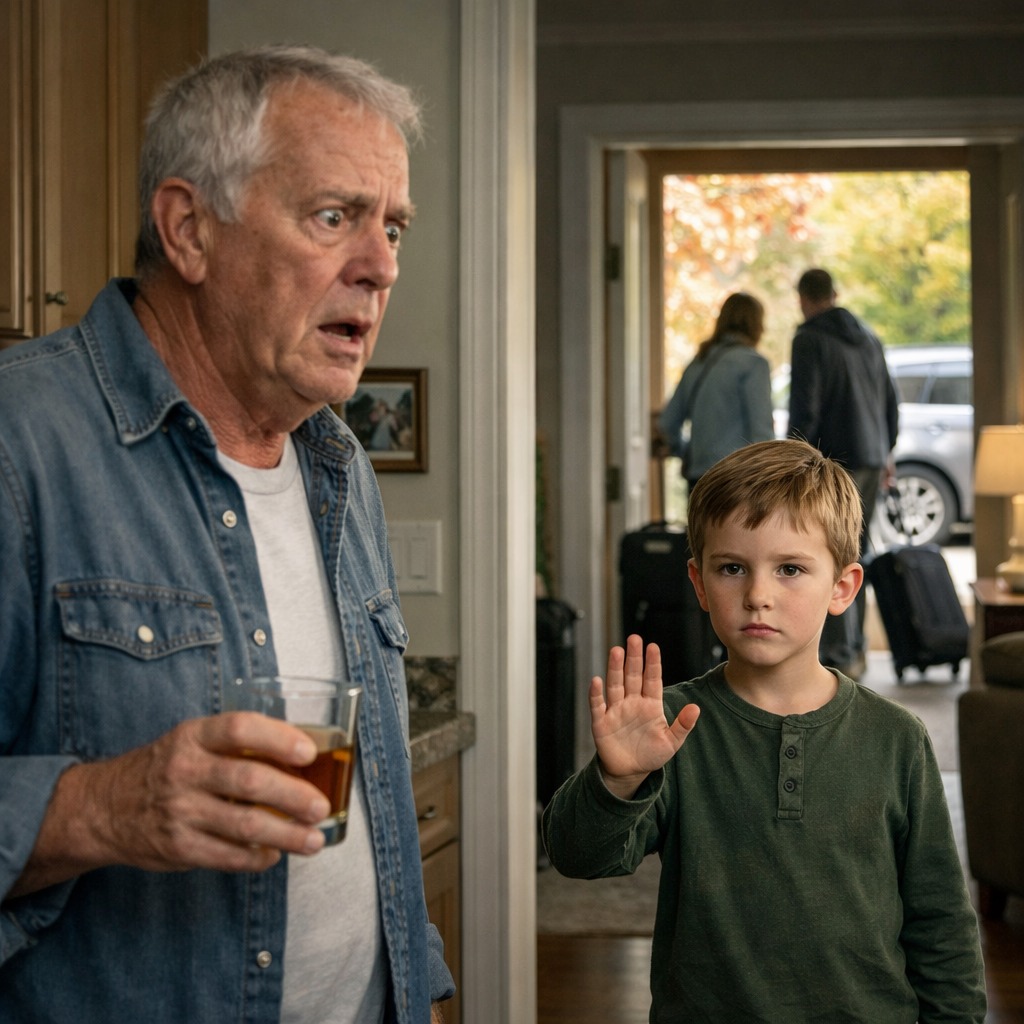
Christopher came in behind her with luggage. When he saw me, color drained from his face.
“Dad,” he said, voice strained. “Are you okay?”
Amber shot him a warning look so fast it made my skin prickle.
“He’s tired,” Amber snapped, then immediately softened. “At his age, these things happen.”
She sat on the couch like she owned my living room.
“Have you been drinking your tea?” she asked, voice sharpened with hunger.
I nodded vaguely. “The tea… yes. Helps me sleep. I sleep so much.”
“That’s good,” Amber said, and she couldn’t quite hide the satisfaction. “Very good.”
Then she turned toward Christopher like she was presenting a report.
“See?” she said. “He’s declining faster than we thought. We need to have that conversation.”
Christopher shifted uncomfortably. “Amber, maybe we should—”
“Christopher,” she cut him off. Hard. “Your father needs help.”
Then she turned back to me, and her mask slipped just enough for me to see the cold underneath.
“Harold,” she said, voice syrupy, “how would you feel about a place where nurses could watch over you? Keep you safe?”
I made my voice small. “I don’t want to be trouble.”
“You’re not trouble,” Amber said, but her tone said you’re inconvenient. “But nature takes its course. Some people… fade.”
The recorder behind the war books on my shelf caught every word.
Amber kept talking. Memory care. Finances. “Handling affairs.” The house. My accounts. “Simplifying things.”
She was getting bolder with every sentence, like she could feel the finish line.
That’s when Lucas stood up.
Slowly. Deliberately.
Amber’s voice cut off mid-sentence.
Lucas walked to the bookshelf, reached behind the old war histories, pulled out the recorder, turned, and faced his mother.
“This has been recording since you walked in,” he said.
Amber’s face went white.
And then Lucas said the sentence that shattered the world we’d been living in:
“And I can talk. I have always been able to talk.”
Silence crashed through the room.
Amber’s mouth opened. “That’s—impossible. You’re mute.”
Lucas’s voice stayed steady. “The doctors you lied to.”
Christopher stared at his son like he was seeing a ghost.
“You can… really…” he whispered.
I stood up, dropping the confused act like a coat.
“He’s been able to speak his whole life,” I said coldly. “Just like I’ve been completely lucid for days.”
Amber stumbled back. “You—what did you do—”
“Stopping your drugged tea works wonders,” I said.
I reached down beside my chair and pulled out the manila folder.
“Your documentation,” I said, laying it on the coffee table. “Your notes. Your planning.”
I read aloud the line about “permanent resolution,” watching Amber’s face twist.
Christopher’s skin went gray.
“Dad,” he whispered, “no… she wouldn’t—”
“She has been poisoning me,” I said. “For two years.”
Amber’s eyes flashed with rage and fear. “This is insane. He’s confused—”
“Mark Stevens ran my blood work,” I said. “It’s confirmed.”
Then I held up the DNA test.
“And you want motive?” I said. “Lucas isn’t Christopher’s biological son.”
Christopher flinched like he’d been hit.
That reaction told me everything.
He knew.
Lucas stepped forward. “I found it two years ago.”
I turned to him. “You’re a Bennett,” I said firmly. “Blood doesn’t make family. Honor does.”
Amber’s face twisted. “That bastard ruined everything—”
She froze.
Because she’d just admitted it.
And then she lunged toward Lucas.
Pure instinct took me. My hand shot out and caught her wrist midair.
“Touch that boy,” I said, voice low and dangerous, “and it will be the last thing you do.”
Amber thrashed. “Let go!”
“He’s not even your real grandson,” she spat.
I held her wrist with the same steady grip I’d used on weapons fifty years ago.
“That boy has more honor than you could have in ten lifetimes,” I said.
I looked at Lucas. “Call 911.”
Lucas didn’t hesitate.
He ran to the kitchen, hands steady, voice clear as he spoke into the phone.
Amber went still when she heard sirens in the distance.
Christopher collapsed into a chair, face in his hands.
“Dad,” he whispered, “I’m sorry. I didn’t know she would actually—”
“You knew enough,” I said.
He looked up, eyes wet. “She threatened divorce. She said she’d take everything. I was trapped—”
“So you let her silence your son for eight years,” I snapped. “You let her poison your father.”
Christopher’s shoulders shook.
Lucas called from the kitchen, “They’re coming, Grandpa.”
Five minutes later, flashing lights painted my living room walls blue and red.
Amber screamed as officers cuffed her, spitting that I’d manipulated Lucas, that the boy was mentally ill, that I was senile.
The officer didn’t argue.
He’d heard the recording.
See more on the next page
Advertisement
