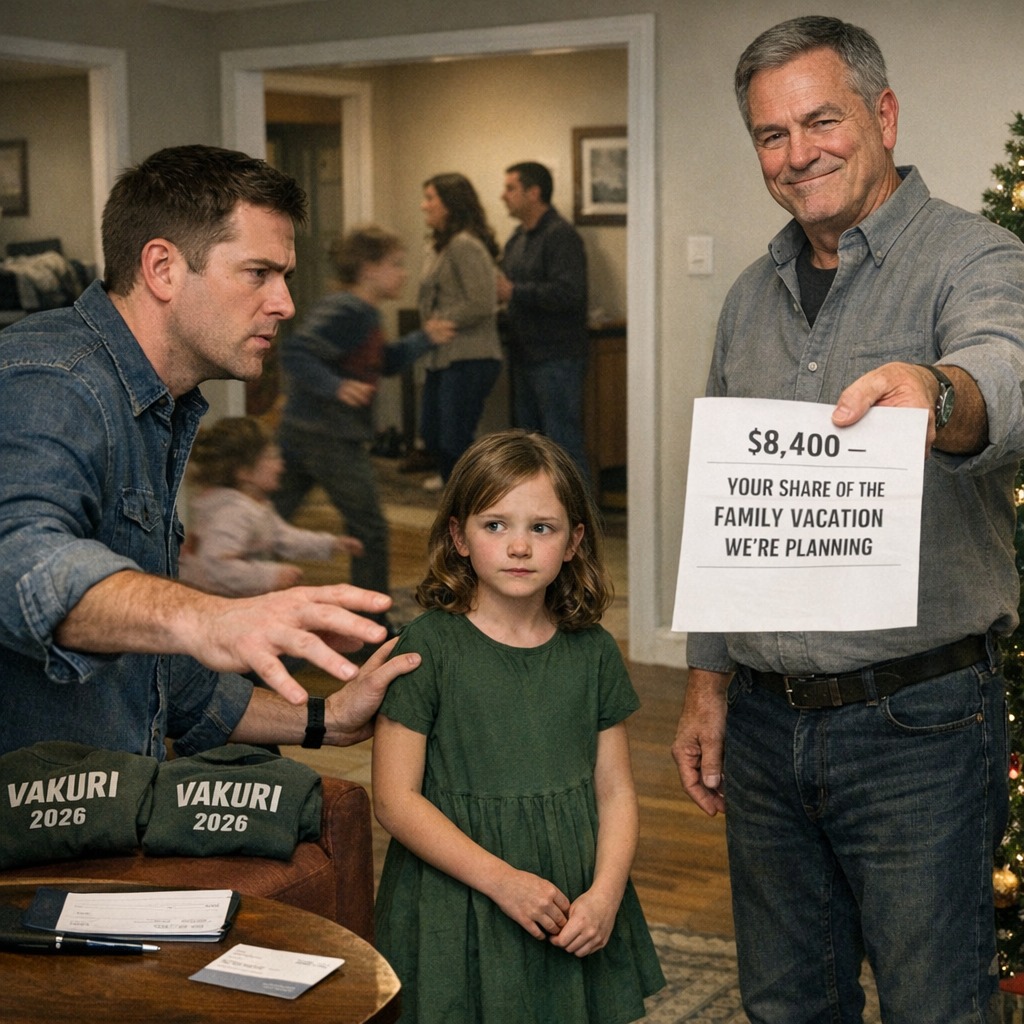
I waited for Dad to say, “And Nora—”
He didn’t.
Instead, he cleared his throat and slid a fourth envelope across the coffee table toward me.
This one was thicker.
Heavier.
“I figure it’s best to be upfront,” he said, loud enough for everyone to hear.
I opened it.
Inside was a single sheet of typed paper.
Neat. Clean. Clinical.
Like a dentist bill.
$8,400 — YOUR SHARE
Under it, in smaller print, was a breakdown:
Flights. Resort. Rental car. Park tickets. Emergency fund. Souvenirs.
And at the bottom, bolded like a final punchline:
Your responsibility: $8,400.
I stared at it so long the numbers started to blur.
Then I looked up.
“What is this?” I asked.
Dad’s eyes flicked to Nora for half a second, then back to me.
“A family vacation,” he said like I was slow. “We’re planning it.”
My mouth went dry. I swallowed.
“I wasn’t invited.”
Beth made a little sound in her throat—a warning sound—like I was about to embarrass her.
Dad didn’t blink.
He smiled.
Not warm. Not awkward.
Confident.
“You’re paying,” he said. “Not attending. Your sister’s kids need this.”
For a second, the room felt too quiet.
I could hear Nora’s shoes squeak against the hardwood as she shifted her feet.
I could hear the faint buzz of the Christmas lights on the tree.
I could hear my own heartbeat in my ears, steady and loud.
“So you bought tickets,” I said slowly, “and made a budget… and decided my role was what? Sponsor?”
Dad shrugged.
“You do well for yourself.”
Beth jumped in fast.
“Dad, don’t make it sound like that,” she said with a bright, forced laugh. “Larry, it’s just… you know how hard it’s been.”
Hard.
In my family, “hard” always meant the same thing:
Larry will handle it.
Nora took a tiny step closer to me. Her hand brushed my sleeve like she was checking that I was real.
I looked down, and her voice came out so quiet I barely heard it.
“Did I do something wrong?”
That was it.
Not the bill.
Not Dad’s smirk.
Not Beth acting like this was normal.
That question—from a kid who had already learned how to make herself small to survive rooms like this—hit me so hard my vision went bright for a second.
My hands shook, but I kept my face still.
I bent down, kissed the top of Nora’s head, and whispered, “No, you didn’t.”
Then I stood up, folded the paper once—carefully, like I was putting away something sharp—and said, “I’ll think about it.”
Dad watched me like he expected a fight.
I didn’t give him one.
I took Nora’s coat from the chair.
Beth’s eyes widened. “Larry, don’t.”
I didn’t slam the door.
I didn’t yell.
I didn’t knock over a decoration.
I just left.
Nora held my hand so tightly in the driveway my fingers went numb. In the car, she stared out the window the whole way home, blinking fast like she was trying not to cry.
I drove with my jaw clenched so hard my teeth ached.
And the whole time, I kept seeing the three white envelopes.
And the empty space where Nora’s should’ve been.
My name is Larry. I was thirty-nine then.
I lived in a two-bedroom rental outside Columbus. I worked as a journalist—local investigative stuff, city contracts, corruption stories, the kind of work that makes you unpopular at parties but helps you sleep at night.
Nora came into my life two years earlier.
She wasn’t my biological kid.
She was my late wife’s niece.
When my wife died, Nora bounced between relatives who meant well but treated her like an inconvenience. A responsibility passed around like a hot pan nobody wanted to hold too long.
I stepped in because I couldn’t stand the thought of her growing up feeling unwanted.
I adopted her not because I was trying to make a statement.
Because she was already mine in every way that mattered.
My family acted supportive at first. They said the right things. They brought casseroles. Dad told people at church how “generous” I was.
But the tone shifted fast.
Nora didn’t match their picture.
She didn’t have Beth’s kids’ loud confidence.
She didn’t call Dad “Grandpa” in a booming voice.
She called him “sir” for the first month because she didn’t know what she was allowed to call him.
Dad pretended not to notice her.
Beth treated her like a guest who stayed too long.
And I—like an idiot—kept trying.
Because I’d spent my whole life trying to earn love in my family with effort and money.
It didn’t start with big asks.
It started with little ones.
Can you cover Dad’s prescription this month? He’ll pay you back.
Can you help with Milo’s braces? Insurance is being weird.
Can you put the plane tickets on your card? We’ll Venmo you.
They always said we.
They always meant me.
Over the years, I paid for Dad’s new water heater when the old one “finally gave out.” (It didn’t. He just wanted a nicer model.)
I covered Beth’s minivan down payment after she cried at my kitchen table about needing something “safe for the kids.”
I paid the family phone plan because Dad liked the idea of one bill.
Beth liked the idea of not paying it.
I bought groceries more times than I can count because Beth would text, Don’t tell Dad, but we’re low until Friday.
I didn’t keep a spreadsheet because I didn’t want to feel bitter.
But after that Christmas, I did the math.
Over about three years, I’d poured somewhere between $22,000 and $25,000 into my family—not gifts, not treating them, plugging holes.
Because if I didn’t plug them, they’d call me selfish.
And the entire time, Nora stayed the plus-one.
The kid whose name got spelled wrong on place cards.
The kid whose stocking got “forgotten” until someone taped printer paper to it.
The kid who got told, “Go play in the other room, sweetie,” whenever adults took pictures.
I swallowed it.
I told myself it wasn’t worth the fight.
I told myself they’d come around.
But the truth was, the more I gave, the more comfortable they got treating me like a utility.
A checking account with a heartbeat.
That Christmas bill wasn’t sudden.
It was the end of a pattern.
Dad had been furious the year before when I refused to co-sign a loan Beth wanted for a bigger place.
I said no calmly. Firmly
See more on the next page
Advertisement
