The older man stopped. He didn’t turn right away. His shoulders rose and fell once, a controlled breath, like he was preparing for impact.
Then he turned.
His face was still stern by habit, but the edges of it looked tired, and Elliot suddenly saw what he had refused to see for years: age had been working on his father in small, silent ways. A stiffness in his stance. A carefulness in the way he balanced his weight on the cane. A look in his eyes that wasn’t anger, exactly.
It was fear.
Fear that it was too late.
Elliot stopped a few feet away, rain-scented air between them, the box still pressed to his chest.
The colonel’s gaze flicked to it.
“You found it,” he said.
Elliot nodded. His voice came out rough. “You brought it.”
A pause.
The colonel’s jaw tightened, as if admitting something cost him physically. “I didn’t know if you’d want it.”
Elliot swallowed. “I lost the first one.”
“I know.” His father looked down briefly. “I asked your mother once what happened to it. She told me you searched for it for days.”
Elliot blinked, stunned. He hadn’t expected his father to know, or to remember.
The colonel’s mouth moved like he was testing the shape of words he’d never learned to speak. “I should have said things. Back then.”
Elliot’s fingers tightened around the box. “Why didn’t you?”
His father’s eyes held his for a beat, then slipped away toward the wet pavement. “Because I didn’t have the language. In my world, love was duty. You provided. You protected. You stayed disciplined so you wouldn’t fall apart.”
Elliot’s chest ached. “And when I chose something else, you treated me like I betrayed you.”
The colonel flinched, small but real. “I was wrong.”
Two words Elliot had never heard from him.
“I thought if I pushed harder, you’d come back to the path I understood,” his father continued. “I thought if you stayed a Walker in the way I meant it, you’d be safe. I didn’t realize I was teaching you that love had conditions.”
Elliot’s voice dropped. “You sent men to scare Hannah.”
The colonel’s face tightened. Shame flickered there, quick as a match struck in the dark. “I ordered a conversation. I didn’t order… that.”
“But it happened,” Elliot said, and the anger returned for a moment, hot and protective. “And it could have hurt her. It could have hurt Mia.”
The colonel’s hands gripped the top of his cane. His knuckles whitened. “I won’t defend it,” he said. “I can only say I was afraid. Afraid you were giving up everything for someone the world would treat as temporary.”
Elliot shook his head. “They’re not temporary.”
Silence again, but different now. Not punishment. Not distance.
A kind of listening.
Elliot drew in a slow breath. “I used to come to your house for holidays thinking if I showed up enough, you’d finally say it.”
The colonel’s eyebrows knit. “Say what?”
Elliot’s voice cracked, but he didn’t back away from it. “That you were proud of me. That you loved me. Anything that didn’t sound like a warning.”
The colonel stared at him, and for a second the mask slipped far enough for Elliot to see something raw underneath.
“I was proud,” the colonel said quietly. “I just didn’t want you to stop moving. I thought praise made people soft.”
Elliot let out a small, breathless laugh that tasted like grief. “And it made me hungry instead.”
His father’s throat worked. He looked older in that moment than Elliot had ever allowed himself to admit.
“I wrote that note,” the colonel said, “because I couldn’t make myself say it to your face without… losing control.”
Elliot held the box up slightly. “But you did bring it.”
The colonel nodded once. “It was the only way I knew how.”
Elliot stared at him for a long moment. Then he took a step closer.
“You can learn,” Elliot said, voice steady. “If you want to.”
The colonel’s eyes flicked up. “Learn what?”
Elliot’s grip on the box loosened a fraction. “How to be here. Not as a legacy. Not as a name. As a person.”
A long pause.
Then the colonel’s shoulders lowered slightly, like a soldier setting down a pack he’d carried too long.
“I don’t know where to start,” he admitted.
Elliot nodded. “I do.”
He turned and looked back toward the yard, where warm lights glowed through the trees, and laughter drifted out like a promise.
“My wife,” Elliot said, the word still new and astonishing, “is inside. Mia too.”
The colonel’s mouth tightened. Fear returned. “I wasn’t invited.”
Elliot looked back at him. “You came anyway.”
The colonel’s gaze dropped to the sidewalk.
Elliot softened his voice. “Come meet them properly. Not as someone sending men in cars. As my father.”
The colonel’s fingers tightened on the cane. Then, finally, he nodded.
Not sharply.
Not like an order.
Like acceptance.
They walked back toward the yard together, slow, careful steps.
When they reached the gate, Hannah noticed first.
She stood from her chair, face alert, protective instinct flickering in her eyes. Mia paused mid-bubble-chase and looked up too, bear tucked under her arm.
Elliot didn’t rush. He stepped forward and held Hannah’s gaze.
“It’s okay,” he said quietly. “He’s not here to take anything.”
Hannah’s eyes moved to the older man. She didn’t smile. She didn’t retreat.
She simply waited.
Elliot turned to his father. “This is Hannah.”
The colonel stood stiffly, like his body wanted to salute the moment. His voice came out rougher than expected. “Ma’am.”
Hannah’s lips twitched, almost amused at the formality. “Hello,” she said calmly. “I’m Hannah.”
Elliot glanced down at Mia. “And this is Mia.”
Mia stared at the colonel with the fierce honesty of children.
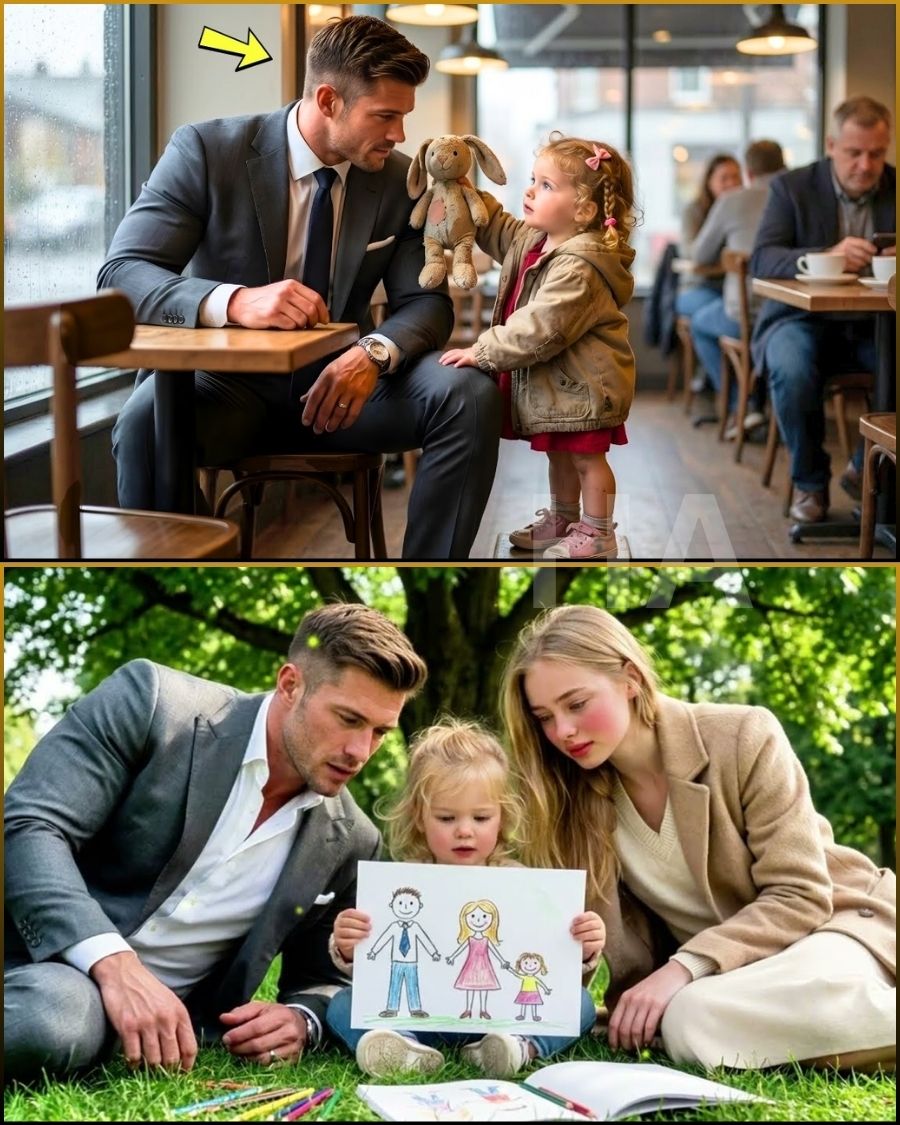
Then she lifted her bear slightly, like a tiny judge presenting evidence. “My bear’s ear got fixed,” she announced.
The colonel blinked, confused.
Mia stepped closer to Elliot and pointed at him. “He fixed it,” she said, proud.
Then she pointed at the colonel. “Did you fix him?”
The question hung in the air, innocent and devastating.
Elliot’s breath caught.
Hannah brought a hand to her mouth, eyes shining.
The colonel stared at Mia as if she’d just spoken a truth he’d avoided his entire life.
After a beat, the older man’s voice lowered. “I’m trying,” he said.
Mia considered this seriously, then nodded once, like granting permission. “Okay,” she said. “But you have to be gentle.”
The colonel’s eyes flicked to Elliot. Something softened there, almost imperceptible.
Elliot knelt in front of Mia, heart pounding. “Mia,” he asked quietly, “do you want to show him your drawing?”
Mia’s face lit up. “Yes!”
She ran inside and returned with a wrinkled sheet of paper. Three stick figures. One tall. One with long hair. One small in the middle.
Mia pointed at each one proudly. “That’s Mom. That’s me. That’s Elliot.”
Then she tapped the word at the bottom, the one she’d written months ago.
“Maybe.”
The colonel stared at the drawing for a long time.
When he finally spoke, his voice was barely above the music. “Maybe,” he repeated, like tasting the word.
Elliot’s throat tightened.
Hannah stepped closer and, without drama, without performance, held out her hand to the colonel.
Not forgiveness on a silver platter.
Just a chance to behave better.
The colonel looked at her hand like it was a foreign object.
Then he took it.
His grip was careful.
Gentle.
One of the guests called for Elliot and Hannah to come back for photos, voices cheerful, unaware of the quiet earthquake happening near the gate.
Elliot glanced at Hannah. She nodded.
“Stay,” Hannah told the colonel softly. “If you want to.”
The colonel nodded once, again.
“I’d like that,” he said.
Elliot didn’t trust his voice, so he just pressed the wooden box into his father’s hands for a moment.
The colonel looked down at the model airplane.
Then, very carefully, he handed it back.
“No,” he said. “It’s yours.”
Elliot held it to his chest again.
They returned to the yard together.
Photos were taken. Cake was cut. Mia danced barefoot until her flower crown slid sideways and she didn’t care.
As the night deepened and the fairy lights brightened, the colonel stayed near the edge at first, like a man uncertain if he had the right to stand in warmth.
But Mia kept drifting back to him, showing him bubbles, then crayons, then a half-eaten cookie she insisted he try.
The colonel’s mouth didn’t quite manage a smile, but his eyes softened each time.
Later, when the guests began to thin and the music became quieter, Elliot found his father sitting alone on the same bench where Elliot had first read the note.
The colonel stared up at the lights in the trees, hands folded on his cane.
Elliot sat beside him.
Minutes passed.
Then the colonel spoke, voice low, brittle with honesty.
“I watched you tonight,” he said. “With them.”
Elliot waited.
“You looked… whole,” his father finished.
Elliot swallowed. “I feel whole.”
The colonel’s gaze stayed forward. “I spent years thinking the goal was strength.”
“It is,” Elliot said. “But not the kind you meant.”
The colonel nodded slowly, as if accepting a lesson too late but still grateful to learn it.
Elliot took a breath. This was the moment. The one he’d rehearsed in his head a hundred times and failed to say.
He turned slightly toward his father.
“I love you,” Elliot said.
The words fell into the space between them like a stitched seam closing.
The colonel’s shoulders went rigid. His eyes blinked once, twice, like he was fighting something invisible.
Elliot didn’t take it back.
He didn’t wrap it in a joke.
He simply sat there, letting the sentence exist.
A long time passed.
See more on the next page
Advertisement
