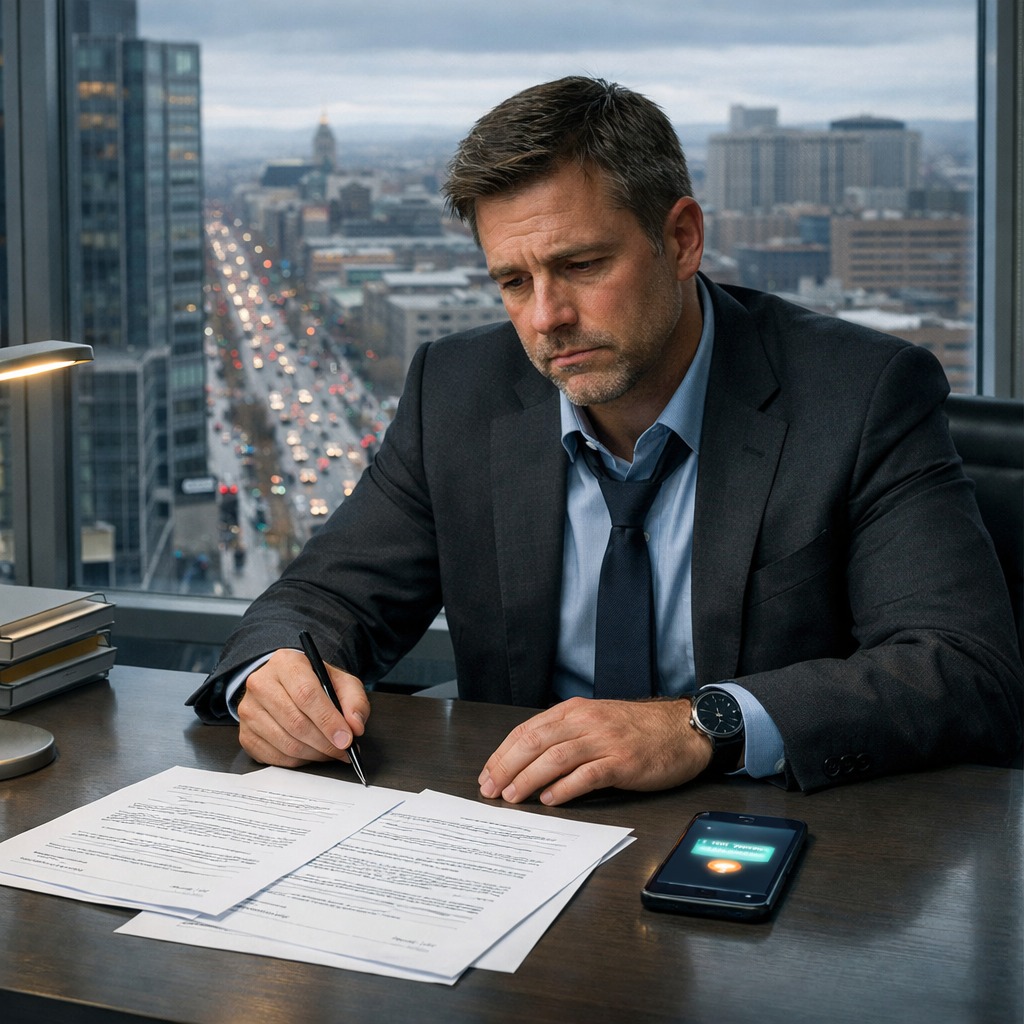
The drive home from the Hendersons’ was a kind of quiet I hadn’t felt before—dense, suffocating, full of unspoken things pressing at the edges. The city lights smeared across the windshield like streaks of gold and red, and the hum of the tires on the highway filled the spaces where words should have been.
Sarah sat beside me, staring out the window, her hands folded neatly in her lap. She always did that when she didn’t know what to say—folded herself into stillness.
I’d learned that pattern years ago, and somehow forgotten it, just like I’d forgotten how to reach her.
When we finally pulled into the garage, she spoke without looking at me.
“Thanks for going tonight.”
Her voice was polite. Too polite.
The kind of tone strangers used at grocery stores.
“Yeah,” I said, my throat dry. “Sure.”
We rode the elevator up in silence. She got off first when the doors slid open, moving automatically toward the guest room.
And something in me broke.
“Sarah,” I said.
She stopped, turned. Her expression was tired, guarded. “Yeah?”
“I need to talk to you.”
Her shoulders stiffened slightly, as if she were bracing for an argument.
“It’s late,” she said softly. “Can it wait until tomorrow?”
“No.” My voice came out quieter than I expected, but firmer. “It can’t.”
She hesitated, then gave a small nod and stepped aside to let me in.
The guest room was neat—too neat. Everything in its place, as though she was trying to create order where everything else in her life was chaos. On the nightstand sat a single framed photo of us from years ago—Lake Tahoe, 2012. Her hair was wind-tossed, and I was laughing at something she’d said.
We looked happy. Uncomplicated. God, I missed those versions of us.
She sat on the edge of the bed, hands clasped, waiting. “What’s this about?”
I stood for a moment, trying to find the right words. None of them seemed good enough.
Finally, I said it.
“I heard you.”
She blinked. “What?”
“At the Hendersons’,” I said quietly. “In Rebecca’s office. I didn’t mean to eavesdrop, but I heard you talking about me. About… us.”
For a heartbeat, Sarah froze. Then the color drained from her face. “Oh, God.” She covered her mouth with her hand. “Michael, I—”
“You said I made you feel safe,” I interrupted gently. “That I was the only man who ever did.”
She closed her eyes. “I shouldn’t have said that.”
“Why not?”
“Because it wasn’t fair. You’ve been working yourself to death, and I’ve been… punishing you for it. I didn’t mean for anyone to hear that. I was just venting, I guess.”
“Venting?” I asked, my voice breaking slightly. “Sarah, you said you thought we were too far gone. You said sleeping next to me felt lonely. That you pushed me away because you didn’t know how to ask for what you needed.”
Tears welled in her eyes, and she looked down. “You weren’t supposed to hear that.”
“I needed to hear that,” I said, stepping closer. “I needed to know that you still cared. Because I thought you didn’t.”
“I thought you didn’t care,” she whispered.
We stood there, two people surrounded by the wreckage of a love that had gone quiet from neglect.
Finally, I took a breath. “I was going to serve you with divorce papers.”
Sarah’s eyes widened, her breath catching. “You what?”
“They’re on my desk,” I said. “I had them drawn up last week. I was going to sign them today.”
She stared at me as if I’d just confessed to a crime. “You… you were really going to do it.”
I nodded. “I thought it was the only way forward. But then I heard what you said tonight. And suddenly—” I broke off, my voice thickening. “Suddenly, none of it made sense anymore.”
Tears slipped down her cheeks silently. “So what are you saying?”
“I’m saying I don’t want a divorce,” I said simply. “I’m saying I’m done running from this. From us. I want to fight for what we still have, Sarah. Because despite everything, it’s still there. I know it is.”
For a long moment, she just stared at me, trembling. Then she let out a shaky laugh. “I thought I’d pushed you so far away that you were already gone.”
“I almost was,” I admitted. “But I didn’t leave. Not yet.”
Sarah wiped her cheeks with the back of her hand. “You don’t know how many nights I lay awake wishing you’d walk into this room. That you’d just… talk to me.”
“I didn’t think you wanted me to.”
“I didn’t think you’d listen.”
We both smiled faintly through the tears, and somehow, that felt like the first bridge we’d built in years.
I sat down beside her, careful to leave just enough distance that she didn’t feel trapped. “So what do we do now?”
Sarah exhaled slowly. “I don’t know. I guess… we start talking. Really talking.”
“I’d like that,” I said.
Her eyes met mine, blue and fragile. “Michael, I need to be honest. I can’t do this halfway. I can’t go back to pretending everything’s fine while we live separate lives.”
“I don’t want that either.”
“I need you to be here,” she said. “Not just physically, but emotionally. I need to feel like I matter more than your job.”
I reached for her hand, hesitating only a second before taking it. “You do matter. You’ve always mattered. I just forgot how to show it.”
For the first time in years, she didn’t pull away.
We sat like that for what felt like forever, our hands intertwined, our silence no longer hostile but healing.
Then, quietly, she said, “We should try therapy.”
It was such a simple suggestion, but it hit me like a revelation. “Yeah. Yeah, we should.”
“We’ve both built walls,” she said softly. “We need help tearing them down.”
I nodded. “I’ll call someone tomorrow.”
Sarah let out a trembling breath, her thumb brushing my knuckles. “Okay.”
We didn’t kiss that night. We didn’t suddenly rediscover the passion we’d lost. But as I turned off the light and left her room, there was a flicker of something between us that I hadn’t felt in years—hope.
The next morning, I did something I hadn’t done in a long time.
I took the day off work.
When I told my assistant, she sounded surprised. “Everything okay, Mr. Chen?”
I looked at the stack of client files, the endless emails waiting for me, the constant noise of a life built on ambition.
“Yeah,” I said. “Everything’s fine. I just need to take care of something important.”
That “something” was us.
I called a marriage counselor—Dr. Patricia Morrison, a therapist recommended by a colleague who’d quietly mentioned her during his own divorce scare. When her receptionist said she had an opening the following Tuesday, I took it.
When Sarah came home that evening, I told her.
“She can see us next week,” I said. “Tuesday at five.”
Sarah looked at me for a long time, like she was waiting for me to change my mind. When I didn’t, she nodded slowly. “Okay.”
And for the first time in years, she smiled—small, uncertain, but real.
That night, I went into my office at home.
The divorce papers were still there, waiting.
I stared at them for a long while.
Then I picked them up, tore them down the middle, and fed the pieces into the shredder.
The sound was louder than I expected. It felt like an ending—but also, maybe, the start of something new.
The next few days were awkward. We moved around each other carefully, like people relearning how to live in the same space. But it wasn’t cold anymore. It was cautious warmth—the kind you protect because you’re afraid to lose it again.
We started having breakfast together, small talk about the weather, about errands. Nothing deep, but it was something.
On Friday night, I came home early—intentionally early—and found her on the couch watching a movie. “Mind if I join?” I asked.
She looked up, startled, then smiled faintly. “Sure.”
We sat together in silence. Halfway through the movie, her hand brushed mine on the couch. She didn’t pull away. Neither did I.
When it ended, she looked at me and said, “This feels… different.”
“It is,” I said. “It’s a start.”
The following Tuesday came sooner than I expected.
Dr. Morrison’s office was small, warm, and painted in calm shades of cream and sage. She greeted us with a smile that reached her eyes. “I’m glad you both came,” she said.
For an hour, we talked—or rather, we started to.
Sarah explained how she’d felt invisible, how my long hours and late nights had made her feel like a ghost in her own marriage.
I admitted how I’d felt unappreciated, like nothing I did was ever enough. How I’d mistaken her silence for disinterest, when it had really been pain.
Dr. Morrison listened patiently, then said something that stuck with me:
“Love doesn’t die overnight. It fades when it’s neglected. But anything that fades can also be rekindled—if both people are willing to tend to it.”
That night, on the drive home, neither of us said much. But when we got inside, Sarah turned to me and said softly, “I’m willing.”
“So am I,” I said.
And I meant it.
Part 3
See more on the next page
Advertisement
