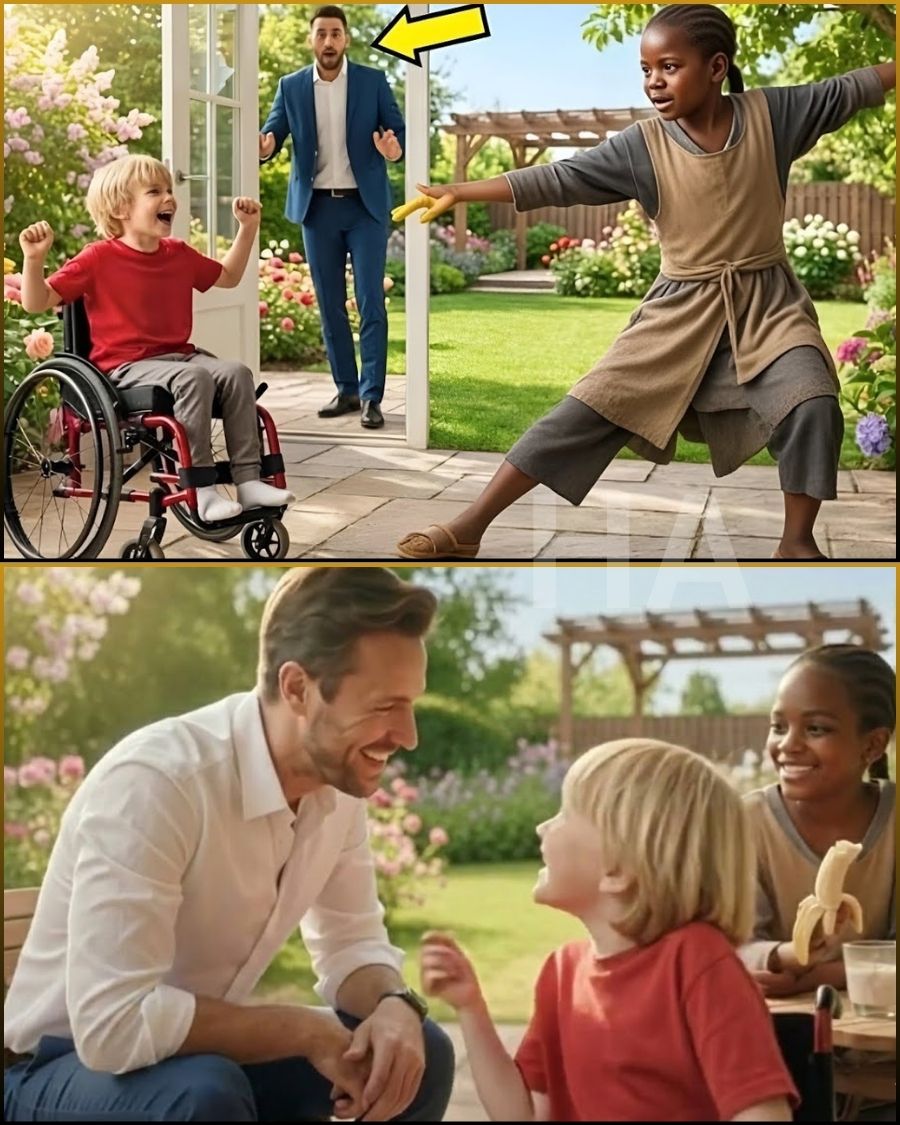
Cal looked like he wanted to argue. Then he did something that surprised Marcus.
He softened his voice.
“Is she safe?” Cal asked quietly. “Out there?”
Marcus held his gaze. “No. That’s the problem.”
Cal’s jaw flexed. For a moment, he looked less like a guard dog and more like a man who’d seen too much of the world’s cruelty.
“I’ll adjust the perimeter,” Cal said slowly. “But I need rules.”
Marcus nodded. “Fair.”
So they made rules.
Amara would come through the patio gate at the same time each day.
She would not be alone with Oliver without Marcus or Evelyn in the house.
They would involve a professional, someone who understood child welfare better than a billionaire did.
And most important, they would never make Amara feel like a criminal for needing a place to breathe.
When Marcus explained the rules to Amara later that day, she listened with narrowed eyes.
“So… you’re not kicking me out,” she said, suspicious.
“No,” Marcus said.
Amara stared at him a long time. “People always say no,” she murmured, “until they do it anyway.”
Marcus didn’t rush to reassure her with empty promises. He’d built his life on trust contracts, but he realized children like Amara didn’t sign those.
They watched.
“Then watch me,” he said quietly. “Watch what I do.”
Amara’s grip tightened on her backpack strap.
Oliver rolled closer, looking between them. “She’s a warrior,” he insisted, as if that settled everything.
Amara’s mouth twitched like she was trying not to smile. “Yeah,” she said. “I’m a warrior.”
Then, like she needed to prove she wasn’t soft, she lifted the banana sword again and shouted, “General! The kingdom is under attack!”
Oliver squealed with laughter.
Marcus felt his chest ache with something close to gratitude and something close to grief.
Because he realized he’d almost lost this. Not to the accident. To his own fear.
The accusation happened the following week, and it nearly shattered everything.
It started with a missing watch.
One of Marcus’s old watches, a gift from his father long before he’d learned to hate his father’s emotional distance. It was a simple piece, not flashy, but heavy with memory.
Lorna approached Evelyn in the kitchen, voice tense. “Mrs. Whitfield,” she said, “your husband’s watch is missing from the dresser.”
Evelyn frowned. “Maybe he moved it.”
“I checked,” Lorna insisted. Her eyes flicked toward the patio. “That girl was in the room yesterday.”
The air changed.
Evelyn’s face tightened. Marcus saw her mind racing through her own fears again, all the ones she’d tried to bury for Oliver’s sake.
Marcus walked in mid-conversation and heard the word “girl” spoken like a warning.
He held up a hand. “Stop.”
Lorna’s cheeks flushed. “Sir, I’m not accusing, but…”
“You are,” Marcus said calmly. “And you’re doing it because she’s poor.”
Lorna bristled. “That’s not fair.”
Marcus’s voice didn’t rise. “Then don’t be unfair.”
Evelyn stepped closer to Marcus, voice low. “Marcus… we have to consider—”
“We consider facts,” Marcus interrupted gently. “Not assumptions.”
Oliver rolled into the kitchen, eyes wide. He’d heard. Of course he’d heard.
“Amara didn’t steal,” Oliver said, voice shaking. “She wouldn’t.”
Amara stood in the patio doorway, frozen, banana in her hand like she didn’t know whether to fight or run.
Her face was blank in the way some children go blank when they’ve been hurt too many times.
“See?” she said quietly. “This is the part where you do it anyway.”
Marcus’s throat tightened. “Amara—”
She took a step back. “It’s fine,” she said, but her voice wasn’t fine. It was thin and sharp. “I get it.”
Then she turned and ran.
Oliver cried out her name.
Marcus moved without thinking, following her out the patio gate and into the street, ignoring Cal’s startled shout behind him.
Amara ran fast, backpack bouncing, mismatched shoes slapping pavement. Marcus followed, suit jacket flapping, breath burning.
He caught up near the corner, where the estate wall ended and the city began to show its cracks.
“Amara!” he called.
She stopped abruptly, spinning to face him with eyes that looked older than ten.
“You’re going to tell me to leave,” she said. “Just say it. Don’t make it nice.”
Marcus bent forward, hands on his knees, catching his breath. “I’m not telling you to leave,” he said, breathless.
She laughed once, bitter. “Sure.”
Marcus straightened slowly. “I’m going to find the watch,” he said. “Because that’s what you do when something goes missing. You look for it. You don’t blame the nearest hungry kid.”
Amara’s lips trembled slightly, and she pressed them together hard like she refused to cry.
“You don’t know people,” she whispered.
Marcus nodded, because she was right.
“I’m learning,” he said. “Come back. Please.”
Amara’s eyes flicked behind Marcus, as if expecting security to appear and grab her. When no one did, she hesitated.
“Oliver’s scared,” Marcus said softly. “He thinks he’s losing you.”
Amara’s face flickered at Oliver’s name, like a crack in her armor.
“I don’t belong there,” she whispered.
Marcus held her gaze. “Belonging isn’t something you earn,” he said. “It’s something people choose to give you.”
Amara stared at him like he’d spoken a strange language.
Then she said, very quietly, “People don’t give that.”
Marcus didn’t argue with her experience. He just offered a hand, palm up, not grabbing, not forcing.
“Walk back with me,” he said. “Let’s prove something together.”
Amara looked at his hand for a long moment.
Then, slowly, she stepped closer.
She didn’t take his hand.
But she walked beside him.
When they returned, Marcus went straight to Oliver’s room, opened drawers, checked pockets, searched like a man on a mission.
He found the watch exactly where it had always been: in a small box behind a stack of papers Marcus had shoved aside weeks ago.
He carried it to the kitchen and placed it on the counter in front of Lorna.
Lorna stared, face draining.
“I found it,” Marcus said evenly.
Evelyn pressed her fingers to her lips. Shame crossed her face too, because she’d almost believed it.
Oliver looked at Amara, eyes wide with relief.
Amara didn’t look triumphant. She looked tired.
Marcus turned to Lorna. “You owe her an apology,” he said.
Lorna’s voice shook. “I’m sorry,” she said to Amara, but it sounded like words she didn’t know how to mean yet.
Amara nodded once, expression guarded.
Then Oliver rolled forward and held out the banana sword. “Warriors don’t quit,” he said.
Amara stared at him, and her face softened in a way that made Marcus’s chest ache.
“Warriors don’t quit,” she repeated.
She took the banana back.
And the kingdom survived another day.
But Marcus understood something now.
If they were going to do this, really do it, they couldn’t just rely on goodwill inside the walls of a mansion.
They had to face the world outside it.
The call to social services happened because the world always notices when the powerful do something messy.
Not maliciously, not always. Sometimes it was just the machinery of society grinding into motion.
A neighbor saw Amara come through the gate and decided to “report a concern.”
A charity board member heard Evelyn mention “a homeless child” and whispered it into a room full of donors like it was scandal.
Someone posted something online: Billionaire letting a street kid live in his house? Weird.
Within a week, Marcus got a polite voicemail from the Department of Child and Family Services requesting a meeting.
Evelyn listened to the voicemail twice, face pale.
“We tried to do this carefully,” she whispered.
“We are,” Marcus said, though his stomach tightened. “This is part of carefully.”
Amara, when she learned about the appointment, went silent.
She didn’t shout. She didn’t run.
She just got quieter, which scared Marcus more.
“I’m not going back,” she said flatly.
“Back where?” Marcus asked gently.
Amara’s eyes flicked up, sharp. “You know.”
Marcus didn’t, not fully. He knew “homeless.” He didn’t know the story inside it.
Evelyn sat with Amara that afternoon on the patio steps, keeping her voice soft.
“Amara,” Evelyn said, “we aren’t trying to trap you. We’re trying to help.”
Amara hugged her backpack. “Help means rules,” she said. “Help means you belong to somebody who can do whatever they want.”
Evelyn’s voice cracked slightly. “Not always.”
Amara’s laugh was small and bitter. “Always for me.”
Marcus crouched in front of her, careful not to crowd her.
“Tell me what happened,” he said.
Amara’s gaze dropped to the grass. For a long time she didn’t speak. The silence stretched.
Oliver rolled closer, not pushing, just being there.
Amara finally whispered, “My mom used to have an apartment.”
Marcus waited.
“She used to have a job,” Amara continued, voice thin. “Then she got sick. Then the rent got late. Then the landlord got mean. Then… we left.”
Evelyn’s eyes filled.
Amara swallowed hard. “We stayed with my uncle for a while. He taught me the moves. He said if I learned how to stand like a warrior, I’d remember I was one even when I wasn’t standing.”
Oliver’s breath caught.
See more on the next page
Advertisement
