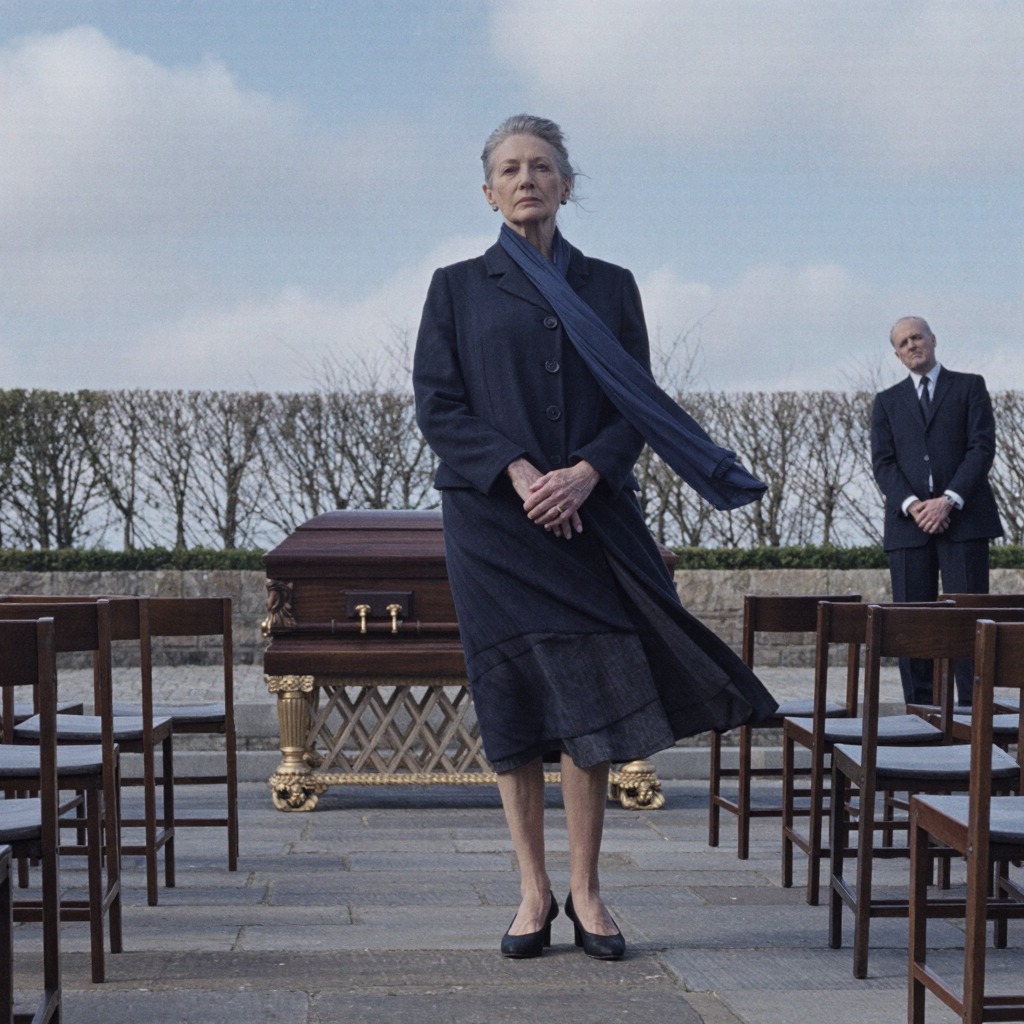
It started with a walk.
Not to pick up prescriptions or return a dish or drop off a casserole.
Just… to walk.
The morning air was brisk. I put on George’s old windbreaker, the navy one with frayed cuffs, and stepped outside with no destination except “around the block.”
The Mapletons’ house still had the same blue shutters. The Wilsons’ porch swing still creaked the way it had when George said, every spring, “We should fix ours before that one falls.” We never did. Neither did they.
At the park, I sat on our old bench under the elm tree that had split in a storm back in ’99 and refused to die. It leaned a bit now, but it still stood.
Two young mothers pushed strollers along the path, chatting about sleep schedules and pre-schools. They didn’t look at me. I didn’t need them to.
A woman in her forties eased herself onto the other end of the bench. She had the tired but functioning look I recognized from my own middle years—hair pulled back in a hurry, clothes that were practical, not pretty, eyes scanning a mental list even as she sat.
“You come here often?” she asked after a few minutes, still looking straight ahead.
“Used to,” I said. “Back when people needed rides and casseroles.”
She laughed softly. “That sounds nice.”
I shrugged. “It was… busy.”
“I’m here to clear my head,” she admitted. “My daughter just told me she doesn’t think she wants kids. Says she doesn’t see the point.”
“What did you say?” I asked.
“I told her I didn’t see the point in her five tattoos, but I manage to keep that to myself,” she said, then groaned. “Except I didn’t keep it to myself.”
We both laughed. We talked for fifteen minutes about nothing important and everything that mattered—about daughters and expectations, about the way the world feels different when you realize you’re not needed the same way anymore.
We didn’t exchange names.
We didn’t need to.
When she left, I watched her walk away, shoulders a little looser than when she sat down.
That night, I made dinner just for me.
Not quick food. Not a frozen meal eaten over the sink. An actual dinner.
Roast chicken. Potatoes. Carrots. Rosemary from the bush George planted by the back steps.
I set one place at the table. I used the good dishes. I lit a candle.
I ate slowly, hearing the tick of the hallway clock between bites.
Afterward, I washed the dishes, dried them, and put them away.
Then I did something I hadn’t done in decades.
I danced.
Not well.
Not long.
But enough.
I pulled the old record player from the den, dusted it off, and dropped the needle on the album George and I used to play when the kids were at sleepovers. The speakers crackled. The song skipped every third line.
He’d always said, “It’s got more charm with the scratch.”
He was still right.
I danced in my living room barefoot, arms loosely raised, knees complaining, hips stiff. I probably looked ridiculous.
No one was watching.
That was the point.
At some point, I wandered toward the fireplace. It hadn’t been used since the last winter George was alive. A thin layer of ash still clung to the grate.
I knelt, cleaned it carefully, swept the old away. In a basket of kindling, I found a folded note.
George’s handwriting.
Keep dancing, even if it’s just in the kitchen. The world will try to make you forget who you are. Don’t let it.
I sat back on my heels, dust on my fingers, tears finally sliding down my cheeks.
He had known.
Not the details, not the empty chapel, not the Instagram posts. But he’d known what the world does to women like me—how it chips away, asks for more, tells us that peace is something we have to earn by exhausting ourselves.
He’d left a little signpost in case I ever needed it.
That night, I opened my bedroom window an inch and let the autumn air sweep in. It smelled like dying leaves and something cleaner underneath.
I fell asleep not to the drone of a late-night talk show, but to the sound of my own house shifting and settling.
It didn’t feel like loneliness.
It felt like life continuing.
Meredith’s PIE and Ethan’s Plans
I didn’t expect Meredith.
She arrived one afternoon without Peter, without a car I could see. When I opened the door, she stood on the porch holding a store-bought apple pie like a peace offering.
“It’s apple,” she said, sounding almost shy.
I stepped aside.
She walked in slower than usual, eyes wandering over the pictures in the hallway, the coat rack George had made in 1981 with one peg forever missing after Peter broke it as a child and lied about it. George had never fixed that peg.
“It’s part of the story now,” he’d said.
In the kitchen, Meredith hovered awkwardly.
I didn’t offer tea.
I didn’t offer a chair.
I let the silence run awhile.
“I didn’t come to ask for anything,” she said finally.
“Good,” I said.
“I heard what happened,” she went on. “What you told Peter. About the trust. The house.”
I nodded, waiting.
“I wanted to say thank you,” she said.
That startled a laugh out of me. “For what?”
“For not giving it to Peter,” she said. “For not giving him one more thing he hasn’t earned.”
She met my eyes, and for the first time in years, I saw her without the gloss—no social mask, no careful projection. Just a tired woman.
“Peter never learned how to stand on his own,” she said. “He grew up with everything handled. I tried to keep up that illusion. You enabling it didn’t help, but neither did I.”
She swallowed.
“Now it’s just who he is,” she whispered. “And I’m tired, too.”
We stood there for a long moment.
“I admired George,” she said. “He was kind to me. Even when I didn’t give him much reason to be. And I know I never said thank you for everything you did—for the help, the babysitting, the money, the… constant yes.”
She grimaced.
“You didn’t owe me thanks,” I said. “You owed him your presence when he left this world. And you didn’t show.”
Her eyes dropped. She nodded once.
She reached into her purse, pulled out a small photograph. It was Ethan at five, on my backyard swing. I’d taken it on a Sunday afternoon, arms and legs pumping, mouth wide open in a laugh.
“He loves you,” she said. “You know that, right?”
“I do,” I said.
“I hope one day he loves someone the way he loves you,” she added, voice catching. “And I hope he knows how rare that is.”
She set the photo on the counter, squared her shoulders.
“I won’t take up more of your time,” she said. “I just wanted to say this before the story gets rewritten. Before they turn you into the villain in their version.”
She walked to the door and opened it herself.
“Don’t let them take your peace, May,” she said. “They’ve taken enough.”
Then she was gone.
I put the pie in the fridge.
It would be good with tea tomorrow.
Trust, Snow, and What’s Next
See more on the next page
Advertisement
<
See more on the next page
Advertisement
