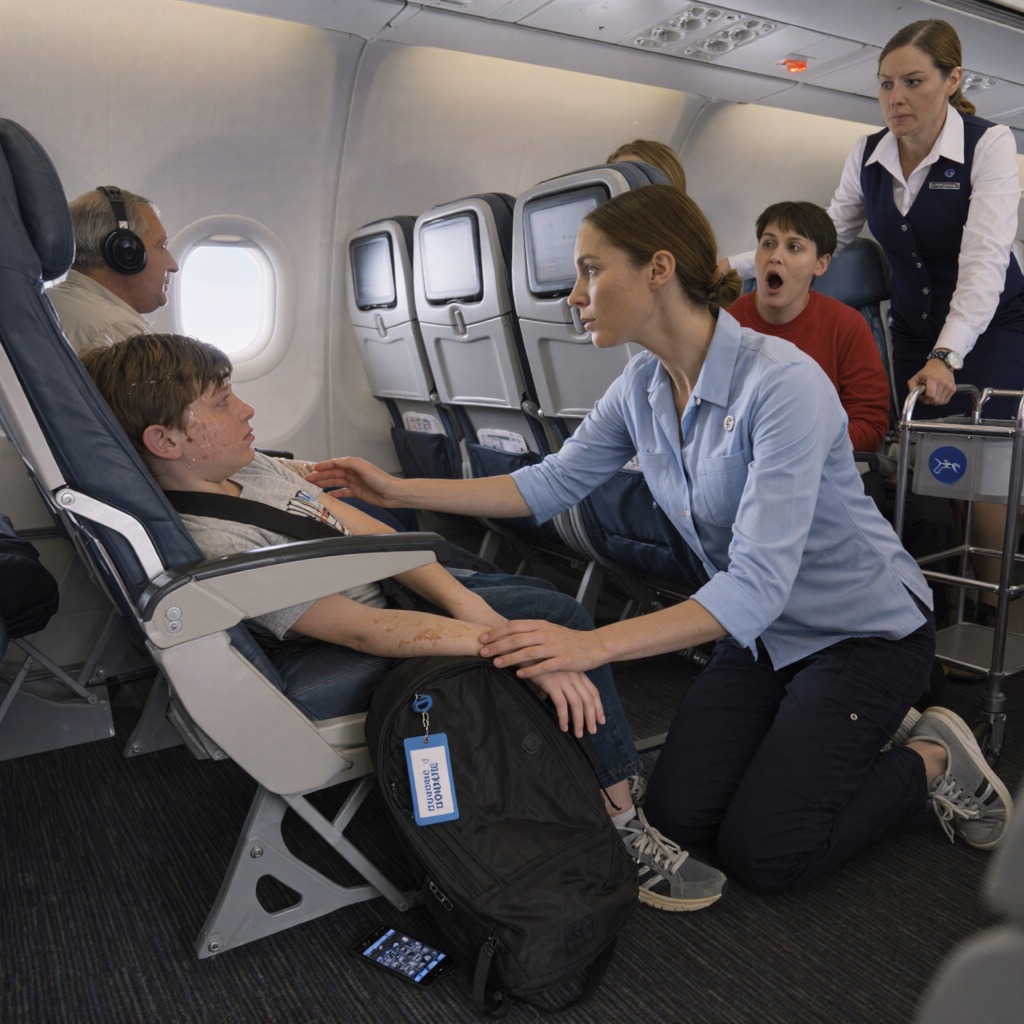
The first thing I noticed wasn’t the sweating.
It was the way the boy’s hands stopped obeying him.
I was three rows behind him on a red-eye-ish afternoon flight from Phoenix to Newark, the kind of flight where everyone pretends they’re fine while their bodies are quietly bargaining with recycled air. My scrubs were swapped for leggings and a hoodie, but my brain didn’t know how to clock out. Eleven years as a pediatric emergency nurse will do that to you—pattern recognition becomes less of a skill and more of a curse.
He was maybe fourteen. Skinny. Long legs cramped into a seat that looked too small for him. An unaccompanied minor tag clipped to his backpack handle like a label on a suitcase. He’d boarded early with a gate agent’s hand on his shoulder and that careful, practiced smile adults use when they’re trying to calm a kid without admitting they’re nervous too.
Twenty minutes into the flight, his shoulders began to hunch as if he was trying to shrink into himself. He wiped his forehead with the back of his hand. Then again. Then again.
The sweat wasn’t normal “airplane nervous” sweat. It was cold, greasy, wrong.
He fumbled with his phone, dropped it, bent down to pick it up, and nearly pitched into the aisle like his center of gravity had shifted without warning. The woman next to him had noise-canceling headphones and her eyes shut like she’d paid for silence and intended to use every minute of it.
The beverage cart rolled by, and the flight attendant didn’t even glance at him.
I tried to talk myself out of moving. The seatbelt sign was still on. We’d barely reached cruising altitude. People get airsick. People get anxious. Maybe he hadn’t slept.
Then his head lolled slightly and his mouth opened as if he’d forgotten what to do with it.
That did it.
I unbuckled and stepped into the aisle.
The flight attendant at the front of the cabin—mid-fifties, gray hair in a perfect twist, posture like a ruler—shot me a look that said sit down without speaking. I ignored it. When you’ve watched kids seize because someone decided “they’re probably fine,” your tolerance for polite compliance disappears.
I reached his row and knelt beside his seat, keeping my voice soft.
“Hey, sweetheart. Are you okay?”
His eyes found mine—unfocused, watery, a little panicked. His lips moved.
“I… don’t… my bag… I can’t…”
Slurred.
Not drunk-slurred. Not goofy. Neurologic slurred.
My stomach dropped into my shoes.
“Are you diabetic?” I asked.
A weak nod.
“Do you have glucose tabs? Juice? Anything with sugar?”
He tried to lift his arm toward the overhead bin. The motion looked like it took everything he had. His fingers trembled like he was shivering from the inside.
Hypoglycemia. Hard and fast.
I pressed the call button—once, twice, three times—until I could hear the chime echoing down the cabin.
The flight attendant arrived with the expression of someone who’d been interrupted mid-ritual.
Her name tag read: Caroline Brennan.
“Ma’am,” she said, clipped and irritated, “you need to return to your seat immediately. The seatbelt sign is on.”
“This passenger is having a diabetic emergency,” I said, keeping my voice level. “His blood sugar is critically low. I need orange juice or any sugary drink immediately, and I need to check his carry-on for glucose supplies.”
Caroline looked at him for half a second—barely long enough to actually see anything—then looked back at me with visible skepticism.
“He looks fine to me,” she said. “Probably nervous. Young people get airsick.”
Behind her, the boy’s head dipped. His mouth slackened. His breathing went shallow, quick.
“I’m a pediatric ER nurse,” I said, pulling my hospital ID badge from my wallet like I was showing a warrant. “These are textbook signs of hypoglycemia—sweating, confusion, slurred speech, pallor. If we don’t get sugar into him within minutes, he could lose consciousness and suffer seizures, brain injury, or worse.”
Caroline crossed her arms.
“I’ve been a flight attendant for twenty-three years,” she said, “and I can tell when someone is faking to get attention. This kid is fine. He’s trying to cause drama.”
I stared at her, trying to process the words.
Faking.
A child—alone—sweating through his shirt, barely able to speak, and she was calling him a scam.
“Look at him,” I said, my voice rising despite myself. “Look at his skin. His sweating. His confusion.”
Caroline’s mouth tightened.
“Ma’am,” she said, “return to your seat or I will report you for interfering with crew duties and creating a disturbance. That is a federal offense.”
She said federal offense while a child was actively slipping toward unconsciousness.
The woman next to him finally removed her headphones, blinking like she’d resurfaced from deep water.
“Oh my God—what’s happening?”
“He’s diabetic,” I said quickly. “His blood sugar is crashing.”
Caroline lifted a hand like she was conducting an orchestra.
“Everyone remain calm. I’m trained in emergency procedures. This is not an emergency.”
My pulse hammered. My hands were already moving.
I grabbed the boy’s backpack from under the seat and unzipped it. I wasn’t thinking about privacy or airline policy. I was thinking about neurons dying without glucose.
Caroline’s grip clamped onto my shoulder, hard.
“Put that down,” she snapped. “You cannot go through another passenger’s belongings without permission.”
I shook her off and found a small zip pouch labeled DIABETES SUPPLIES in careful block letters, like someone—his mother, probably—had packed it with love and fear.
Inside: a meter, test strips, insulin pens, glucose tablets, emergency contacts, and—thank God—a glucagon kit.
I pulled out the glucose tablets and turned back.
The boy’s eyes had rolled back slightly. His jaw slack.
“I’m going to put these in your mouth,” I told him, even though I wasn’t sure he could hear me. “Try to chew.”
I placed two tablets between his lips.
He didn’t chew.
He couldn’t.
Caroline yanked my arm and physically pulled me away.
“Stop this right now,” she hissed, “or I’m calling the captain to have you restrained.”
A man across the aisle stood up—thirties, baseball cap, the kind of face that looked permanently tired.
“Are you insane?” he said to Caroline. “That kid is in trouble. Let her help him.”
Caroline’s cheeks flushed red. “Sir, sit down immediately.”
He didn’t.
“I’m calling 911,” he said, pulling out his phone.
Caroline actually laughed.
“We’re at thirty-five thousand feet. There is no 911. I’m in charge of passenger safety.”
The boy’s head tipped forward.
And then he went limp.
Something in me clicked into a colder gear.
If she wouldn’t call it in, I would.
I pushed past Caroline and grabbed the intercom phone near the galley.
“This is a medical emergency,” I said into it, projecting through the cabin. “I’m a nurse. There is a diabetic passenger in row eight losing consciousness. I need the captain to declare a medical emergency and prepare for priority landing.”
Caroline ripped the phone from my hand and slammed it back into place.
“You just committed a federal crime,” she hissed. “Unauthorized use of aircraft communication systems. You’re going to be arrested the second we land.”
The overhead speakers crackled.
“This is Captain DeMarco,” a voice boomed. “Did someone just report a medical emergency?”
Before Caroline could answer, multiple passengers started shouting.
“Yes!”
“He passed out!”
“She won’t help!”
“That kid is unconscious!”
The cabin erupted. People stood, craned their necks, phones rising like periscopes. Voices overlapped, angry and scared, the kind of chaos that happens when ordinary people realize authority is failing in real time.
Captain DeMarco’s voice cut through.
“Flight attendant Brennan, report to the flight deck immediately.”
Caroline shot me a look of pure hatred and stormed forward toward the cockpit.
The moment she was gone, the air in the cabin changed—like we all exhaled at once.
I dropped back beside the boy.
His pulse was thready under my fingers. Breathing shallow. Skin cold and clammy.
The man across the aisle reappeared holding a small bottle of orange juice.
“I grabbed it from the galley,” he said. “Will this help?”
“Yes,” I said, taking it like it was gold.
I tilted the boy’s head, opened his airway, and dribbled tiny sips into his mouth, watching carefully to make sure he swallowed. Most of it ran down his chin. Some went down.
Not enough.
He needed glucagon.
I ripped open the emergency kit from his pouch, hands trembling now—not from fear, but from the pressure of time. I’d done this hundreds of times in the ER. I’d never done it wedged between airplane seats while strangers watched and someone filmed.
“Okay, Ian,” I murmured, reading the name off his emergency card because names anchor people. “Ian, I’m going to give you medicine that raises your blood sugar.”
I found the injection site on his thigh and administered the glucagon.
Then we waited.
Those minutes felt like hours.
A woman two rows back was crying silently, hands pressed to her mouth. Someone was filming openly now. The woman who’d been seated next to Ian held his emergency contact card with shaking fingers.
“His name is Ian Fletcher,” she said out loud, voice cracking. “His mom’s number is here. Should I call?”
“Yes,” I said. “Call her. Tell her he’s alive, and we’re getting him help.”
A younger flight attendant hurried up—mid-twenties, ponytail, eyes wide.
“I’m Amy,” she said. “What happened?”
I didn’t bother softening it.
“I called for help fifteen minutes ago,” I said. “Caroline refused to believe it was real. She tried to stop me.”
Amy’s face drained.
“Oh my God,” she whispered, and knelt beside me to check his pulse. “Did you give glucagon?”
“Three minutes ago.”
Amy pressed her fingers to his wrist, then looked up like she was trying not to swear.
“I’m so sorry,” she said. “I was in the back. I didn’t know.”
Captain DeMarco came over the speakers again.
“Ladies and gentlemen, we are declaring a medical emergency and will be making an emergency landing in Albuquerque in approximately twenty minutes. Please remain seated and keep the aisles clear.”
Twenty minutes.
In a hospital, twenty minutes is a long time. On a plane, it’s an eternity.
I watched Ian like my eyes could will him alive.
Four minutes after the injection, his eyelids fluttered.
Five minutes, a small sound in his throat.
Six minutes, his fingers twitched.
“Ian,” I said, leaning close. “Can you hear me? You’re safe. Your blood sugar dropped. We gave you glucagon.”
His eyes opened—unfocused and frightened.
“Where?” he whispered.
“You’re on a plane,” I said. “You got low. Do you remember eating today?”
He swallowed, grimacing.
“Forgot,” he mumbled. “Breakfast. Felt sick.”
Classic. A nervous kid traveling alone, skipping a meal, insulin still on board, blood sugar collapsing like a trapdoor.
Amy brought more orange juice and crackers. Ian managed to sip, shakily. Color began to creep back into his cheeks.
Behind us, phones kept recording. The story was already leaving the plane.
Caroline reappeared near the back of the cabin, arms crossed, glaring as if the problem wasn’t a child nearly dying—it was me refusing to obey.
The landing into Albuquerque was rough. Fast. The plane hit the tarmac hard enough for gasps to ripple through the cabin.
The moment we stopped rolling, the door opened and paramedics rushed in with bags and a stretcher.
I gave a rapid report while they checked his glucose: 32 mg/dL.
The lead paramedic—Russell, name stitched on his uniform—looked up at me with the kind of respect professionals give each other when they recognize a near-miss.
“You saved his life,” he said. “How long was he symptomatic before treatment?”
I glanced toward the cockpit, where Caroline stood too close to Captain DeMarco like she was trying to control the narrative.
“About twenty minutes,” I said. “Could’ve been five.”
Russell’s expression darkened. “Why the delay?”
The man who’d gotten the juice—David, I’d learned his name in the chaos—spoke up.
“She said he was faking,” David said, voice sharp. “She threatened to have this nurse arrested for trying to help. People recorded everything.”
Russell shook his head in disgust.
“We’ll need statements,” he said. “This is going to be a nightmare for the airline.”
They loaded Ian onto a stretcher and wheeled him off.
Amy touched my arm.
“Thank you,” she whispered. “I’m sorry you were alone.”
I swallowed the anger because there was no space left for it right then.
Caroline approached while I gathered Ian’s supplies to hand to the paramedics.
“I hope you’re prepared for the consequences,” she said coldly. “You violated multiple federal aviation regulations. Interfered with crew authority. Created a panic.”
I stood and looked her in the eye.
“I saved a child’s life while you stood there and watched him die,” I said. “The only person who should be worried about consequences is you.”
Her face flushed with rage, but Captain DeMarco stepped in—gray-haired, tired-eyed, the look of a man who’d just realized someone under his authority had lied to his face.
“Miss Brennan,” he said sharply, “you will report to the flight office immediately when we arrive in Newark.”
Then he turned to me.
“Ma’am,” he said, voice softer, “thank you. From the cockpit, it’s hard to assess. I should have been notified sooner.”
The emphasis on should was a knife aimed right at Caroline.
Newark
See more on the next page
Advertisement
<
See more on the next page
Advertisement
