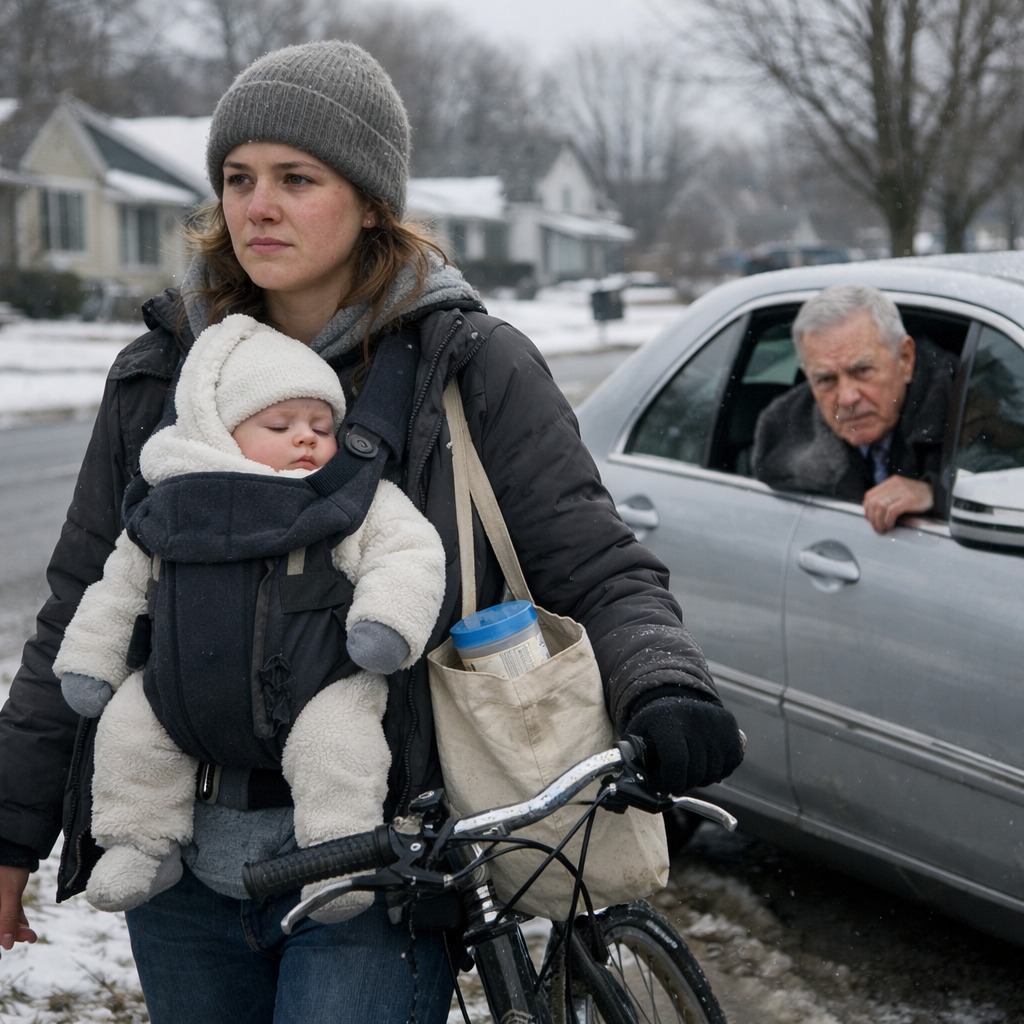
The cold that morning wasn’t the cute, Hallmark kind of winter cold.
It was the kind that turned your eyelashes crunchy and made your lungs feel like they were inhaling broken glass. The kind that made the sidewalk shine like a warning. The kind that took the city—our neat little suburb outside Chicago—and stripped it down to pure survival.
I was outside anyway, because Ethan’s formula was almost gone.
That was it. That was the whole reason.
Not a stroll. Not fresh air. Not “getting steps in.” Just the grim math of motherhood: baby eats, baby lives, and the store doesn’t care that your husband is overseas or that your family treats you like a houseguest who overstayed her welcome.
Ethan was strapped to my chest in an old carrier I’d bought off Facebook Marketplace, the fabric faded and soft from a thousand other mothers’ panic purchases. His tiny face was tucked against me, wide-eyed and quiet. Too quiet, honestly—the kind of quiet that made me wonder what he’d already learned about tension.
I was pushing a secondhand bicycle down the sidewalk with one hand, because the tire had gone flat the moment I left the driveway. The rubber had sighed and collapsed like it couldn’t take another day in this family either.
My fingers were numb, my cheeks stung, and my body still didn’t feel like my own after childbirth. I’d been sleeping in ninety-minute bursts for weeks, and the little sleep I got was the thin kind that didn’t heal anything.
That’s when the black sedan pulled up beside me.
At first, I didn’t recognize it. I just saw the clean lines, the tinted windows, the way it moved like it had a right to the road.
Then the rear window slid down.
“Olivia,” a voice said—deep, controlled, sharp enough to slice through the air.
My stomach dropped.
My grandfather’s face appeared in the window like a storm front rolling in. Silver hair. Steel eyes. The kind of expression that had made grown men sweat in boardrooms.
“Why won’t you ride the Mercedes-Benz I gave you?” he demanded.
It wasn’t a question the way most people ask questions. It was a command disguised as curiosity.
I stopped walking.
The bike tilted slightly, and I caught it before it fell. Ethan blinked at the sudden stillness, his tiny hands tightening against my sweater.
I hadn’t seen Grandpa Victor Hale in almost a year. Not since Ethan was born. Not since Ryan got deployed. Not since I moved back into my parents’ house “temporarily” because “family helps family.”
My parents’ version of help came with strings. Chains, really.
Grandpa Victor’s version came with leverage.
He stared at the bicycle, then at the baby in my arms, then back to my face.
His gaze hardened.
I tried to speak, but my throat was tight. Fear had a familiar grip on me—the old fear of saying the wrong thing and paying for it later.
Still, something inside me—something small and stubborn—refused to lie.
I swallowed.
“I only have this bicycle,” I said, voice trembling. “Mary is the one driving the Mercedes.”
Mary was my younger sister. Twenty-six. Pretty in that effortless way that made people want to excuse her behavior. Loud when she wanted attention, helpless when she wanted money, cruel when she wanted control.
Grandpa Victor’s expression changed so fast it almost scared me.
The calm vanished.
A deep fury settled in his eyes like a door slamming shut.
He didn’t ask for clarification.
He didn’t ask if I was “sure.”
He didn’t ask why.
He simply lifted one hand and made a small gesture toward the driver.
The car door opened.
That door didn’t just open into a warm backseat.
It opened into the first exit I’d seen in months.
“Get in,” Grandpa Victor said.
My legs felt disconnected from my body as I climbed into the sedan with Ethan pressed close. Warm air wrapped around me, smelling faintly of leather and some expensive cologne I couldn’t name. Ethan made a soft sound and relaxed against my chest.
The bicycle was left behind in the snow.
Something about that—leaving it there like a discarded version of myself—made my eyes burn.
Grandpa Victor didn’t ask anything right away.
He stared out the window as we pulled away from the curb, jaw tight, hands folded as if he was holding something back.
The silence was worse than interrogation. It gave my mind room to spiral.
If he went to my parents’ house, they’d spin a story. They always did. They’d tell him I was unstable. Postpartum. Overreacting. Grateful but “confused.” They’d say I misunderstood. That they were “helping.”
They were very good at sounding reasonable.
They were even better at making me sound irrational.
Finally, Grandpa Victor spoke without looking at me.
“Olivia,” he said, voice low. “This isn’t just about the Mercedes, is it?”
I froze.
Ethan’s warmth against me anchored me in place, but fear still climbed my spine.
If I told the truth, my parents could retaliate. They could call Ryan overseas. They could tell him I was unsafe. They could threaten custody. They’d already hinted at it whenever I pushed back.
But Grandpa Victor’s eyes—when he finally turned them toward me—didn’t feel like judgment.
They felt like a spotlight.
And Ethan—this tiny person breathing steadily against my heart—made the decision for me.
This child’s future could not be ruled by that house.
I took a breath.
“Grandpa,” I said, and my voice surprised me with how steady it was. “This isn’t a family issue. It’s a crime.”
His eyes sharpened, like he’d been waiting for exactly that sentence.
I didn’t cry. I didn’t dramatize.
I did what I’d learned to do in survival mode: I gave facts.
The Mercedes—given to me for my marriage and Ethan’s birth—kept “for safekeeping.” The keys held by my mother. The car “assigned” to Mary so it wouldn’t “go to waste.”
My mail redirected or “sorted” without my consent. Bank alerts mysteriously turned off. My debit card “managed” because I was “recovering” and “exhausted.”
And the withdrawals.
Large ones.
Too large.
My mother had told me it was for groceries, diapers, household expenses.
But the numbers didn’t match.
And I’d been too sleep-deprived, too isolated, too ashamed to confront it.
As I spoke, my voice got stronger. Each detail made the situation feel less like a fog and more like a pattern.
Grandpa Victor listened without interrupting.
When I finished, he said one thing to the driver.
“Head to the police station.”
The words hit me like a slap.
My panic flared. “Grandpa—wait. Please.”
He turned, calm and terrifying. “What.”
“I—” My throat tightened. “They’re my parents. If we do this… they’ll—Ryan… Ethan…”
He reached over and closed his hand around mine—firm, grounding.
“Olivia,” he said, voice like stone. “They are using the word family as a shield while stealing the future of you and Ethan.”
I blinked hard.
“This is no longer a family matter,” he continued. “As you said—this is a crime.”
Then, softer—still firm, but human:
“And from this moment on, you and Ethan are under my protection.”
Something inside me cracked open.
Not weakness.
Relief.
The kind that makes you realize how long you’ve been holding your breath.
I nodded once.
“Okay,” I whispered. “Let’s go.”
The police station was fluorescent-lit and smelled like old coffee and winter coats.
If Grandpa Victor hadn’t been beside me, I might have turned around at the entrance and run—back to the familiar misery, back to the control, back to the place where at least I knew how to survive.
But he didn’t give me room to retreat.
Before we even walked in, Grandpa Victor made a call in the car, voice clipped and precise. When he hung up, he looked at me.
“I just spoke to your lawyer,” he said. “He’ll meet us here.”
My lawyer.
I almost laughed at how surreal it sounded.
We were brought into a private room where a female officer met us—mid-forties, hair in a tight bun, eyes tired in the way only people who’ve seen a thousand lies can be tired.
At first, she had that procedural look. The domestic dispute, family drama look.
“So,” she said, pen poised. “Tell me what happened.”
My voice trembled at the beginning. Accusing my parents felt like stepping off a cliff.
But Ethan shifted in my arms, and the weight of him—warm, real—kept me talking.
As I moved from the Mercedes to the money, the officer’s expression changed. The pen moved faster. The questions got sharper.
“Did they give you an explanation for the withdrawals?”
“‘Household expenses.’” My mouth tasted bitter. “But I wasn’t given money for my own needs. I was told there wasn’t enough.”
“And do you recall signing any power of attorney? Any document giving them access?”
“No,” I said. “Never.”
Grandpa Victor, who had been silent, spoke.
“Officer,” he said calmly, “I gifted my granddaughter a trust of one hundred fifty thousand dollars. For her and her child’s future. Documents should have been delivered directly to her.”
The officer’s pen paused.
Grandpa Victor turned to me, eyes narrowing. “Olivia—did you receive those documents?”
My blood went cold.
I shook my head slowly.
“No,” I whispered. “I didn’t even know it existed.”
The room changed.
It wasn’t subtle.
The officer’s posture straightened. Her eyes sharpened with something like anger.
This was no longer “parents helping their daughter.”
This was concealment. Exploitation. Theft with planning.
When I finished, the officer set her pen down and looked at me directly.
“Thank you,” she said, voice softer. “I’m sorry you had to relive that. We’re accepting your report as a criminal case.”
She glanced at Grandpa Victor, then back at me.
“We’re opening an investigation for theft, fraud, and—based on your descriptions—coercive control.”
The phrase landed like validation I didn’t know I needed.
Coercive control.
A name for the thing that had been choking me for months.
We left the station after dark, the sky bruised purple.
The car drove in the opposite direction of my parents’ house.
Toward Grandpa Victor’s estate.
A place I’d visited as a child, where the air smelled like wood smoke and books and safety.
The gates opened, silent and smooth, and for the first time in a year I felt like my body unclenched.
Inside, the staff had already prepared a room with a crib.
They didn’t ask questions. They didn’t judge. They just moved with quiet competence—like in Grandpa Victor’s world, problems got solved, not performed.
After Ethan was placed gently in the crib, I collapsed on a sofa, the adrenaline finally draining.
I expected tears.
Instead, anger flooded in—hot, clean, unfamiliar.
My grandfather stood behind me.
“Are you afraid?” he asked.
I stared at the fire in the fireplace.
“No,” I said, surprised by my own answer. “I’m angry. And I’m thinking about what they’ll do next.”
Grandpa Victor nodded once, satisfied.
“This is not a fight you started,” he said. “It’s a war they initiated.”
He looked down at me, his voice going colder.
“And during war, mercy is unnecessary.”
I slept for the first time in months.
Not the shallow, anxious kind.
Real sleep.
The kind that makes your body remember it’s allowed to rest.
When I woke up, my phone was vibrating relentlessly on the nightstand like it was trying to jump off.
Missed calls.
Voicemails.
Texts.
All from my mother, my father, and Mary.
The first messages were fake concern.
Olivia, where are you?
Is Ethan okay?
Don’t disappear. You’re scaring us.
Then the tone shifted as I kept scrolling.
Bring the baby back now.
You’re being irresponsible.
Who filled your head with this?
You’re unstable, Olivia. You need help.
Then Mary’s message hit like a knife wrapped in velvet:
If you keep acting like this, I might have no choice but to tell people you’re mentally unstable and not fit to raise a child. I don’t want to do that, though.
See more on the next page
Advertisement
